The saying goes that markets take the stairs up and the elevator down. In late January, that elevator stopped at every floor of software capital structures.
The catalyst was the unveiling of Claude Cowork. Investors began reassessing the durability of legacy SaaS models, and even stronger names traded down as the market tried to price the risk of AI reshaping an entire industry’s revenue model.
9fin identified early signs of dislocation weeks earlier — then tracked the sell-off in real time across loans, bonds, distressed and private credit, and mapped where capital rotated next.
Thanks to 9fin, clients got a connected, global view across public and private credit, with pricing, reporting and analysis in one place.
7+ weeks
805 names
20+ pieces
Fully integrated
The early signals: tracking pressure before the market moved
Before the January shock, signs of dislocation were already appearing in the primary market — and in 9fin's proprietary private credit data.
- 10 October — Examined AI as a live underwriting question across private credit
- 5 December — Reported on AI concerns weighing on the Integral Ad Science loan syndication, signalling growing scrutiny in primary markets.
- 15 December — Analysed the SonarSource $500m dividend recap, highlighting investor debate around AI.
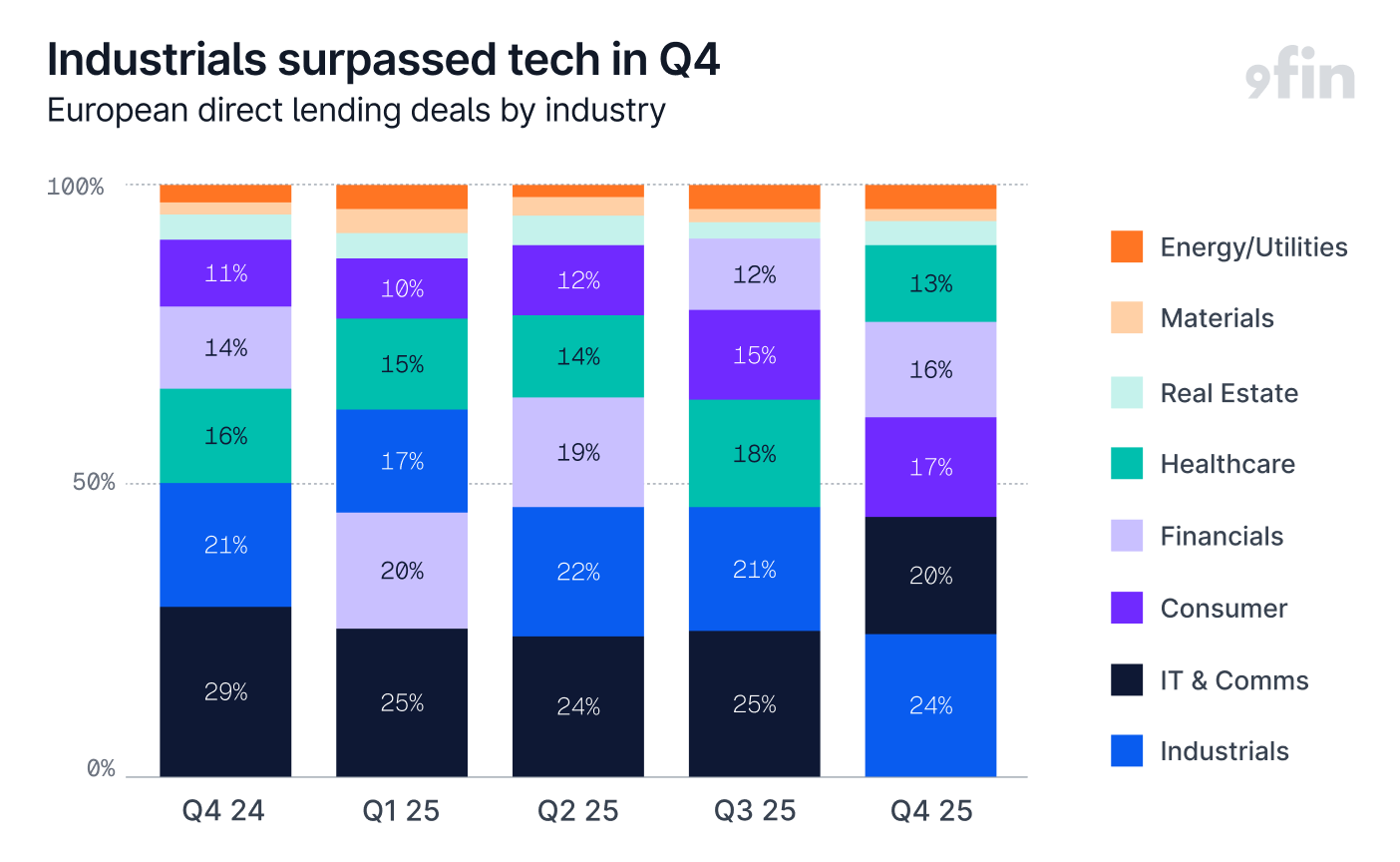
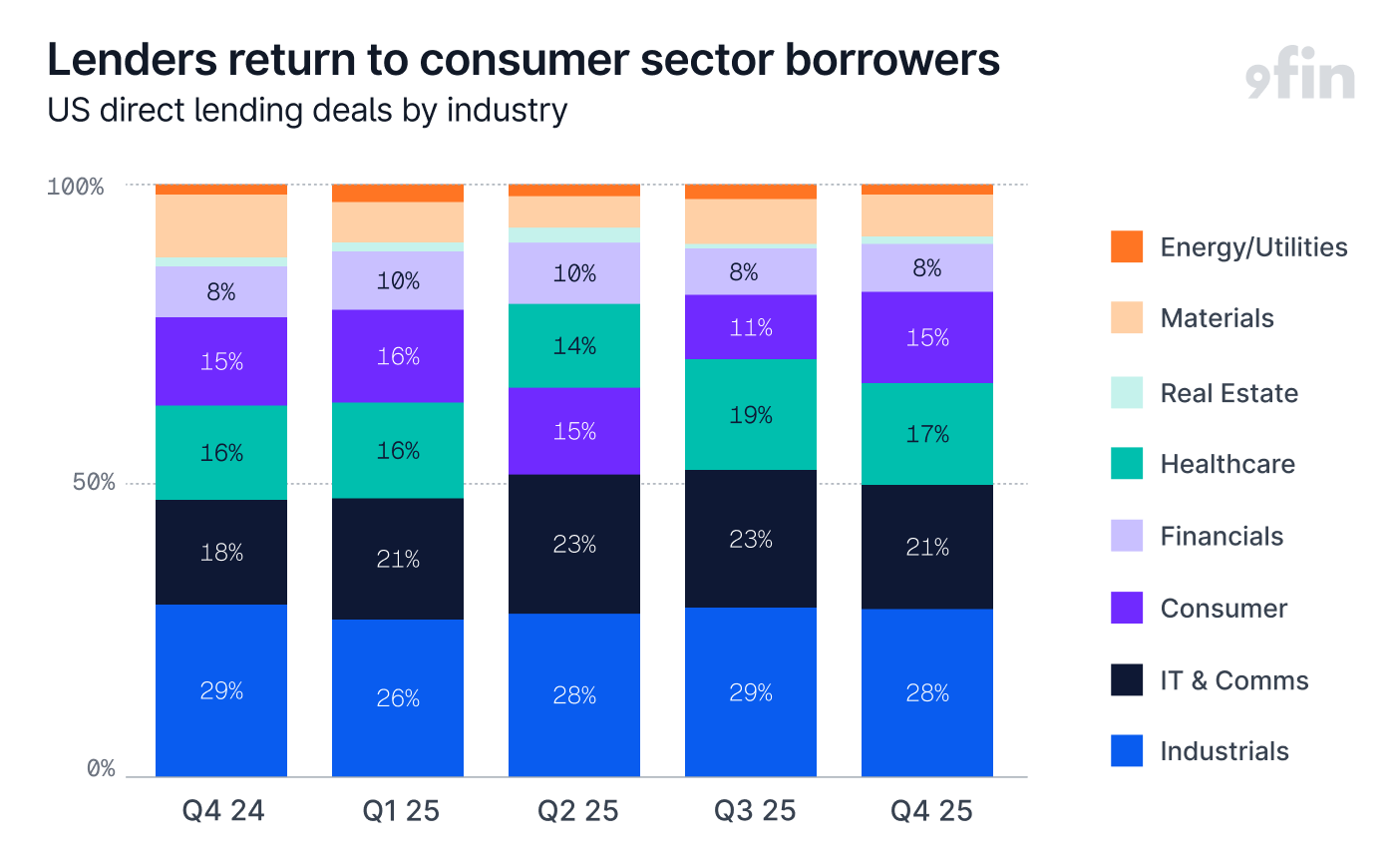
- Q4 2025 — 9fin proprietary data showed private credit funds rotate away from tech; for the first time since Q2 2023, IT & communications is no longer the dominant sector in European direct lending, with a smaller shift toward consumer in the US.
9fin data showed European private credit was already moving away from tech
IT & communications fell to around one-fifth of deal count, the lowest level we’ve seen, as deal count instead pivoted towards industrials
A smaller shift was recorded towards consumer in the US
Source: 9fin private credit data
The repricing: covering every layer in real-time
By late January, the pressure building in private credit became visible across public markets. Spreads widened, and the share of leveraged loans trading below $80 had risen from 5.1% a year earlier to 7.2% — a 26-month high. 9fin's users didn't need five different systems to follow it.
9fin’s coverage spanned every layer simultaneously: secondary spread moves for performing credit, primary syndication struggles, growing distressed classifications, private credit exposure, BDC issuance, and investment grade coverage — all tracked within a single platform.
$110.6bn
36%
16–34bps
–4.0%
In focus: Conga — one transaction, every stage
If one transaction illustrated the breadth of 9fin's coverage, it was Thoma Bravo-backed Conga’s pulled acquisition financing. From the original financing scoop in October through to the deal being pulled in February, 9fin documented every stage in real-time.
What’s more, using 9fin's data and analytics tools, subscribers could move from headline to cap structure, from covenant detail to comparable deals — without switching systems.
| Traditional workflow | 9fin workflow |
|---|---|
| Terminal for pricing | Pricing & news integrated in one platform |
| Separate news feeds for aggregating newsflow | Real-time credit news embedded alongside data |
| Different data rooms, manually read definitions and compare; | AI-powered covenant analysis with side-by-side comps |
| Downloading covenant PDFs from different data rooms, hours spent manually comparing definitions | Searchable documents with instant covenant benchmarking |
| Exporting pricing and financials into Excel, manually selecting relevant issuers | Effortless filtering by sponsor, sector and structure |
| Updating manually as market moves | Live, continuously updating data and alerts |
Across the sell-off: every name, every angle
Conga was one of many. 9fin tracked AI-driven pressure across multiple transactions simultaneously, and covered the macro picture as it developed across every vertical.
| Individual names | Market analysis |
|---|---|
| SonarSource — dividend deal tests software market after AI selloff | Software drives surge in distressed leveraged loans to two-year high |
| Relativity's debut refi weighs AI disruption fears against growth | Private credit defends software exposure amid sector selloff |
| team.blue repricing falls away as AI curbs appetite | Is vibe coding causing a SaaS crash? — Sector analysis |
| Dedalus repricing withdrawn amid AI-induced software suffering | Searching for European opportunities amid software sell-off |
| Cast & Crew lenders tap lawyer amid soft performance | US LevFin Wrap — Software stress tests the tape |
The other side of the trade
As software came under pressure, other parts of the market looked comparatively attractive.
Investment-grade hyperscalers and high-yield data centers stood to benefit from increased AI-related infrastructure spending. Hardware names and certain utilities exposures found themselves on the favourable side of the same thematic shift unsettling SaaS.
9fin’s coverage extended accordingly: investment grade analysis, high yield data centres, and sector pieces exploring where capital might redeploy.
Most of the analyses mentioned in this case study are for clients only — for access, click below to start a free trial.
Your edge when markets turn
When volatility hits, speed and clarity decide who wins.
9fin gives you reporting, data, covenant tools and sector trends in one unified system — so teams can understand exposure, compare structures and act early, without stitching together five different platforms.