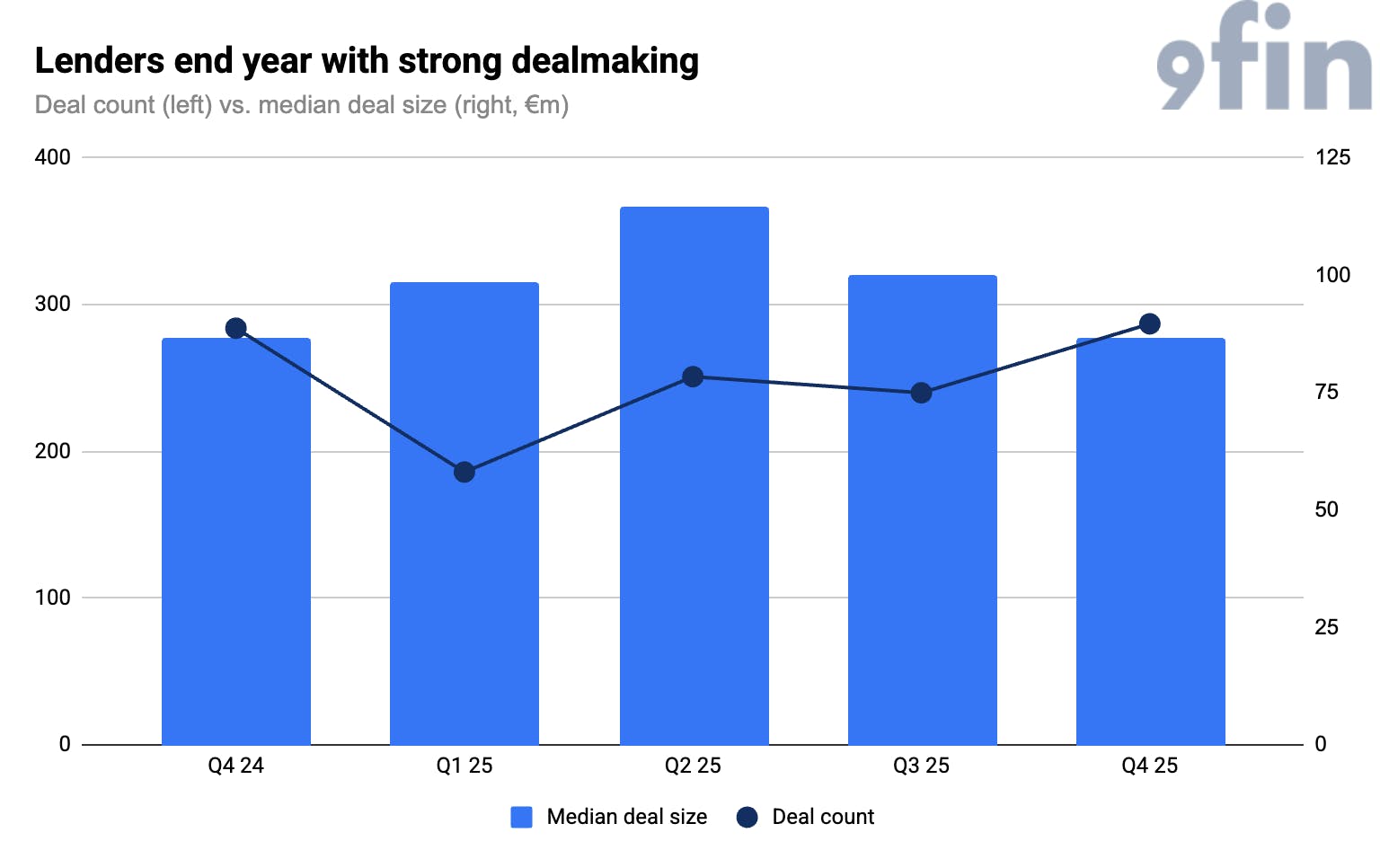
For all the volatility and economic jitters felt through 2025, European private credit ended the year with momentum on several key fronts. The continent’s direct lenders not only maintained a healthy deal flow in Q4, but also battled back against banks’ encroaching market share and ended the year with a robust share of global fundraising.
Deal count ticked up quarter on quarter by nearly 20% to 287, and was also slightly higher than the 284 tracked in Q4 24, despite a slight year-on-year decline in buyout activity.
While the median deal size in the market dropped a second consecutive quarter to €86.6m, that figure is even with its level in Q4 24. The drop back below €100m may simply be a return to normal following a peak in Q2, when private credit firms found a new competitive footing against public markets rattled by tariffs.
While tight pricing remains a potential drag for lenders, the strong deal and fundraising activity shows that their perseverance through the year, even without the surge in buyout activity for which the market has continued to hold on hope.
A new normal for pricing?
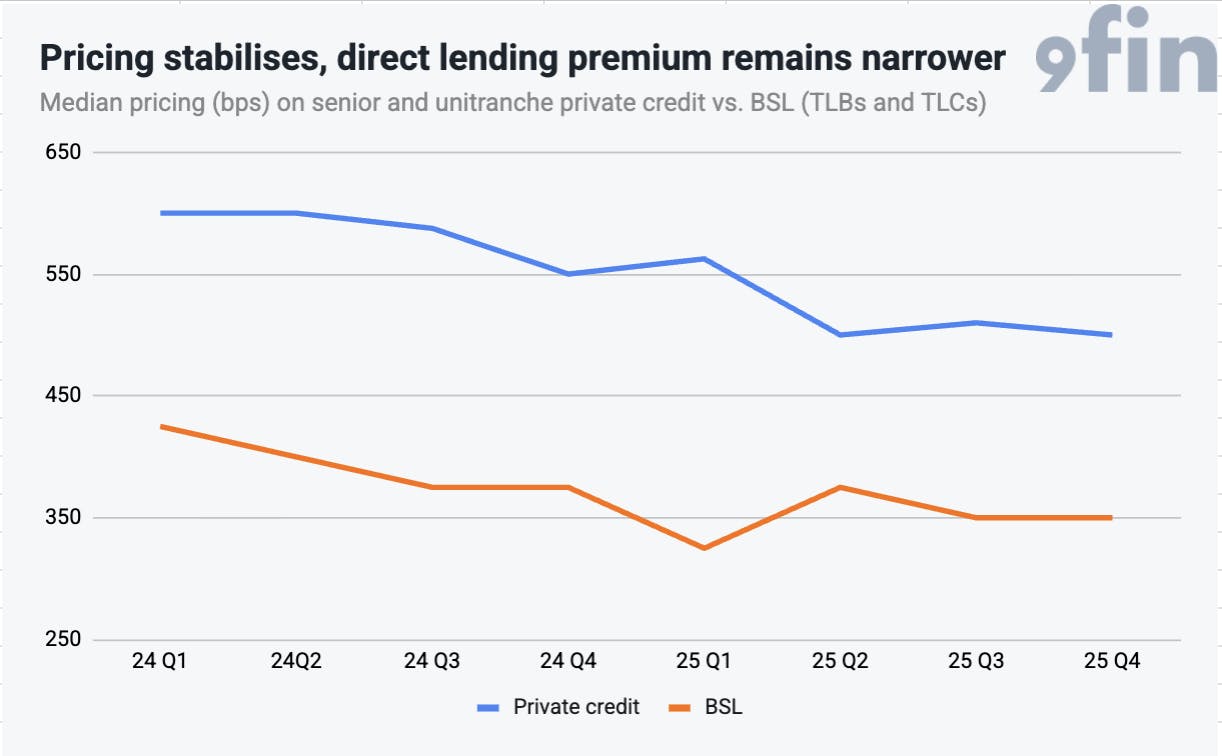
Private credit spreads began a gradual decline in 2024, but at the time they moved alongside debt pricing in the broader market and direct lenders kept their historic premium of around 200bps over syndicated loans.
The more precipitous drop first seen in Q2, when lenders wrestled for bigger credits and more market share against bank-led lending, proved to be temporary. However, the median spread on senior and unitranche loans once again declined slightly to 500bps in Q4, only a 150bps premium over syndicated TLBs and TLCs.
While our pricing data has been revised upward since our last quarterly report (historical figures in our reports sometimes change due to the receipt of new information), Q4 marked the third in a row with pricing around the 500bps mark and a narrowed premium over public markets, perhaps reflecting a new normal.
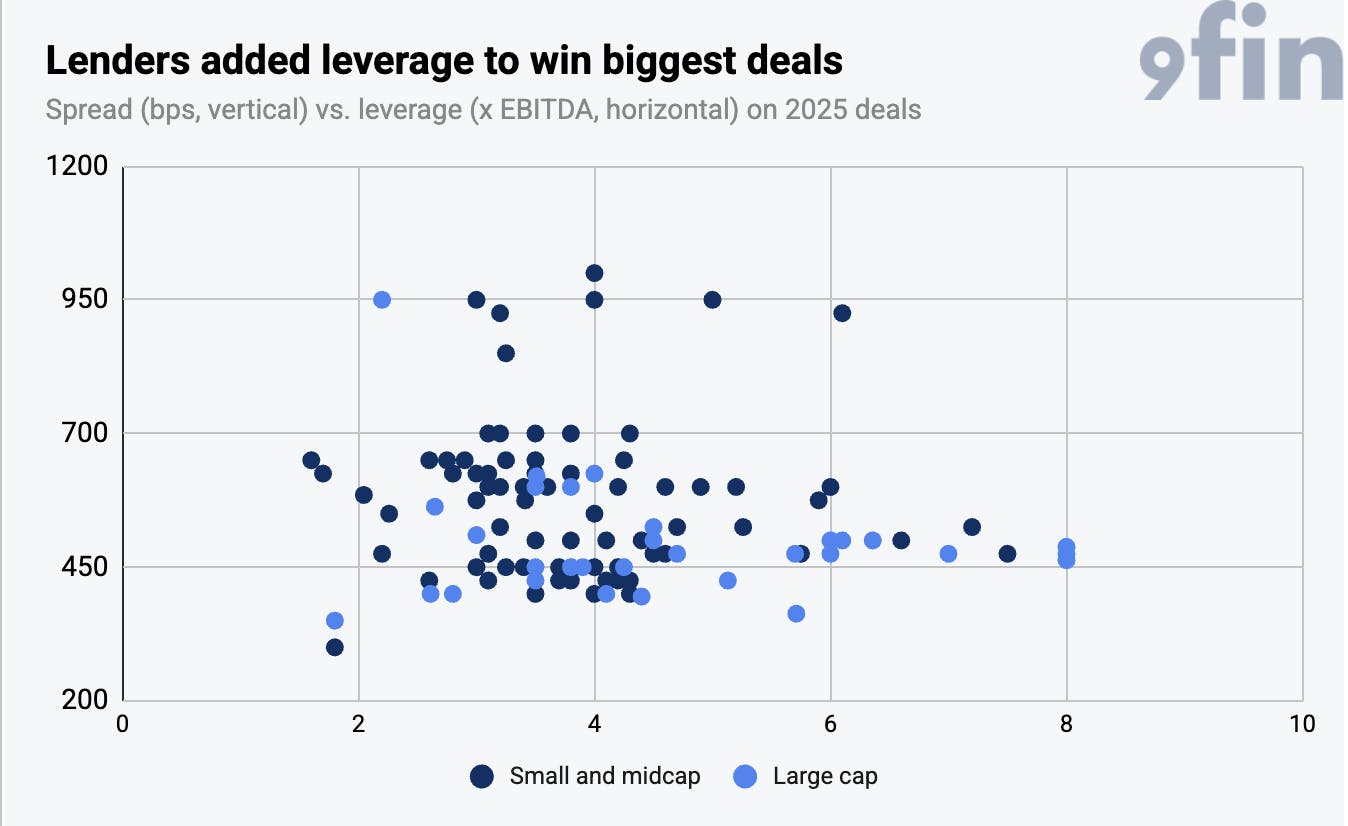
Moreover, the median figures belie a willingness to drop well below 500bps, especially for larger or more attractive credits where lenders face more competition. Lenders repeatedly showed a willingness this year to go as low as 425bps for the hottest credits.
The below plotting of leverage and margin levels on this year’s deals shows the dispersion in the market, with lenders willing to add two more turns of leverage or drop pricing below 450bps to close larger deals.
Despite the competitive pressure on pricing throughout the year, lenders were able to avoid some other concessions on deals in Q4, minimizing their issuance of subordinated debt and agreeing to fewer PIKs.
Subordinated debt fell to 4% of instruments issued in Q4, down from 8% a year ago and 7% last quarter. Meanwhile, only 3% of instruments included PIK, down from 7% in each of the prior two quarters.
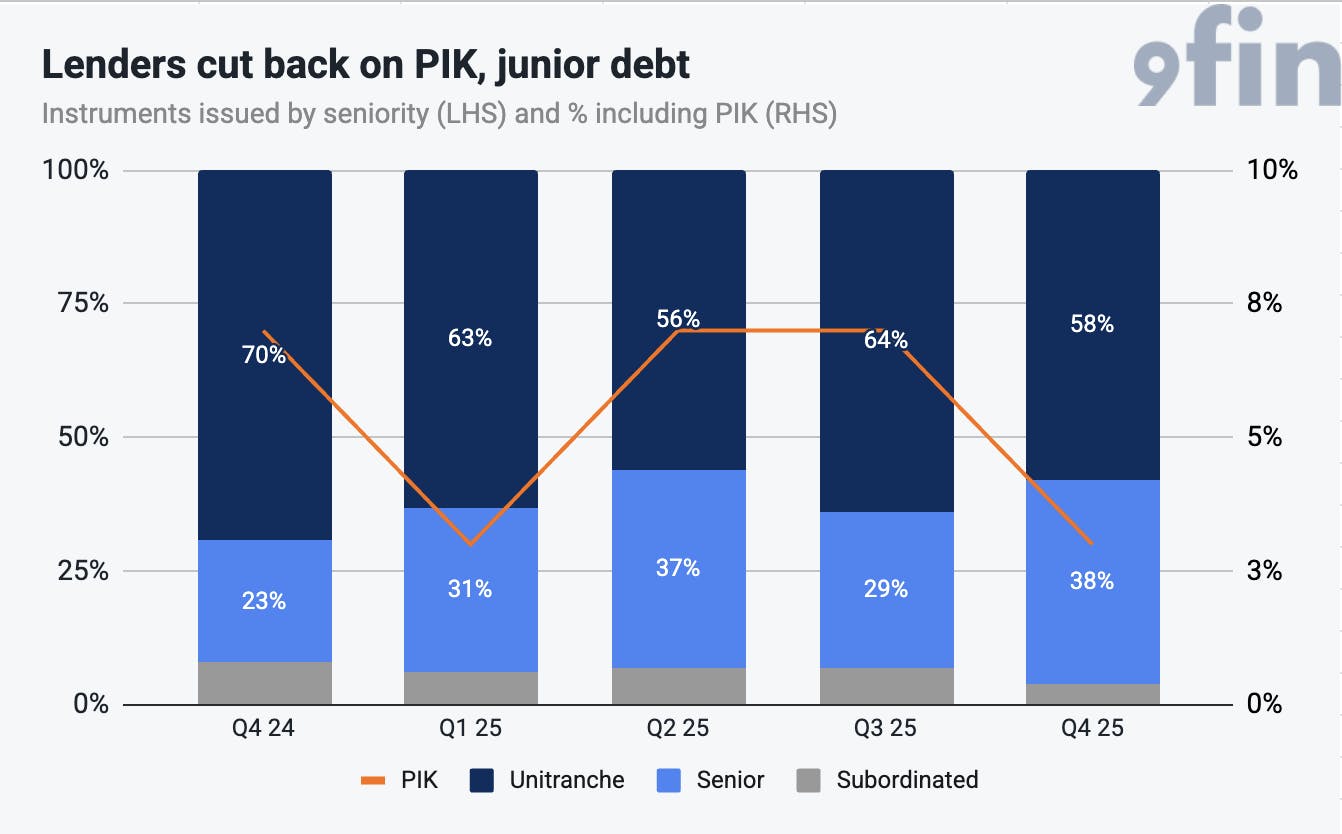
Private credit gains back market share
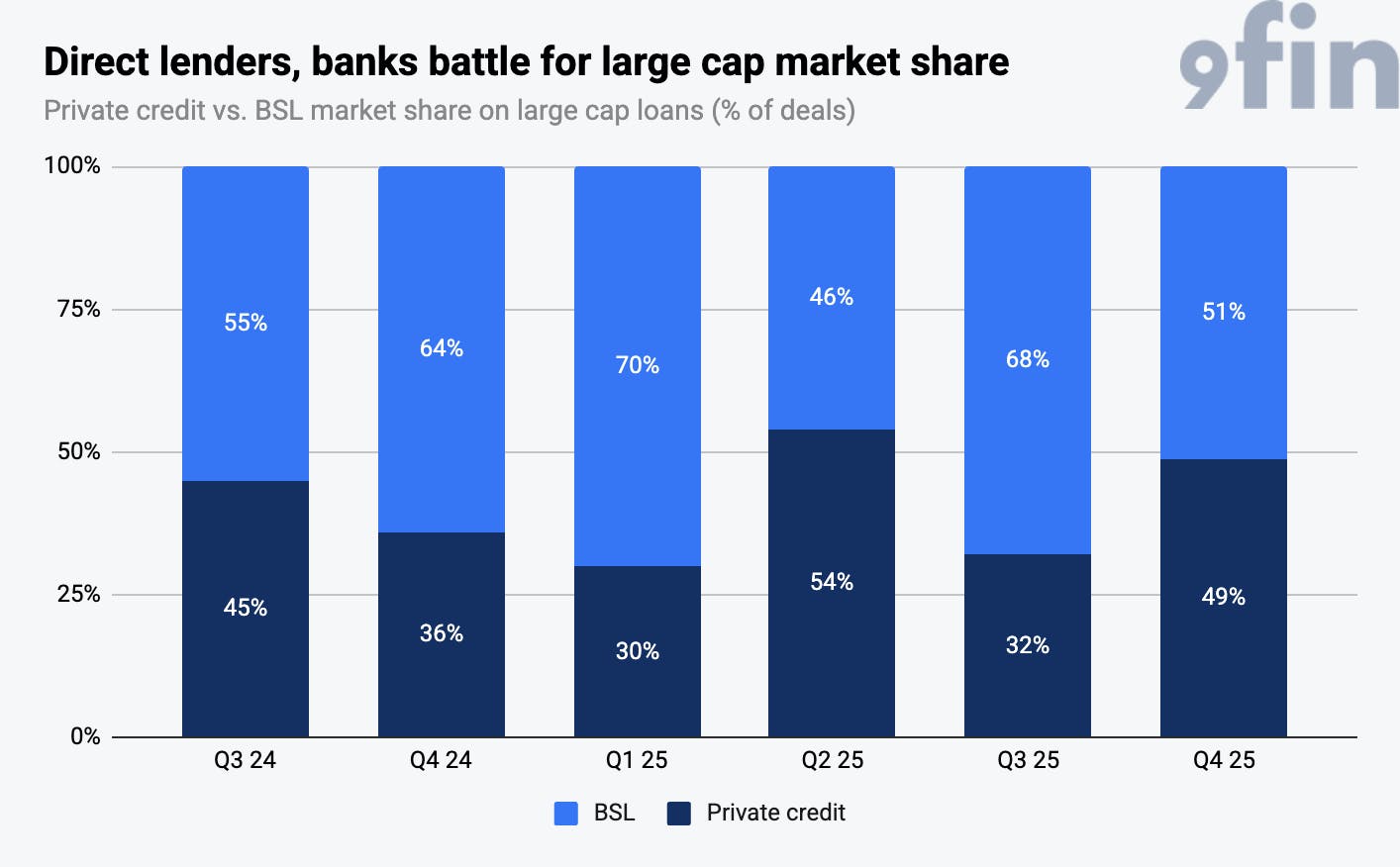
Aggressive pricing, moreover, appears to have paid off in winning large-cap deals from the syndicated market. Private credit providers and banks split roughly evenly the market for large-cap leveraged loans, those issued to firms with more than €50m in EBITDA or representing more than €250m in total debt.
That’s the highest market share achieved by private credit in several quarters, setting aside the highly volatile Q2.
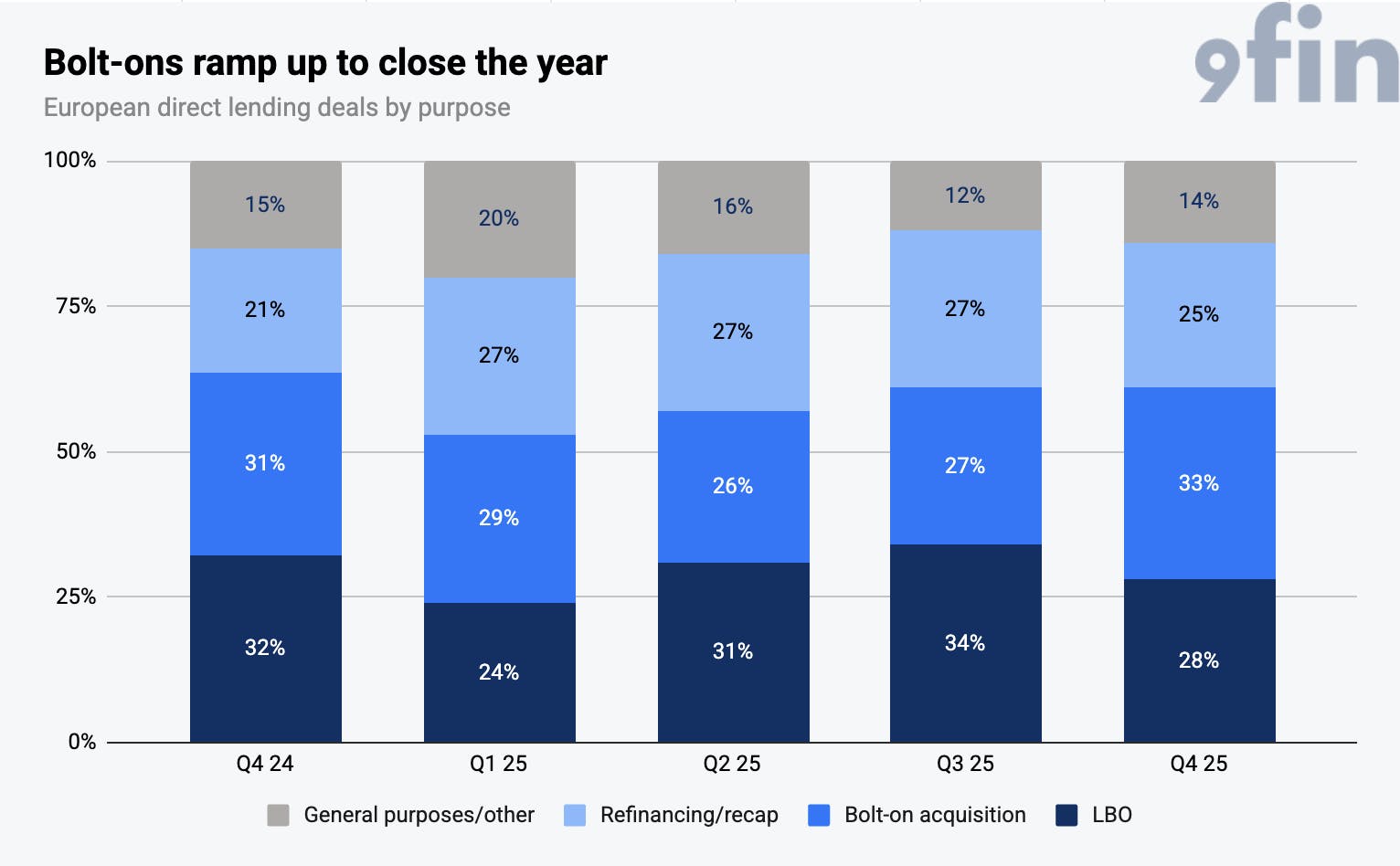
One important caveat to that increased market share, however, is that lenders continued to lean into bolt-on acquisitions, suggesting much of their activity focused on existing portfolio assets rather than the new credits that come with primary LBOs.
Add-on acquisitions accounted for about one-third of private credit deals in Q4, the highest in recent quarters.
Indeed, 2025 remained relatively slow on the buyout front. Private credit funds financed 290 buyouts over the year, a slight decline from 293 in 2024. However, that includes a particularly slow Q4 year on year, with 79 LBOs vs. 93 in 2024.
Aside from the £1.5bn package provided by Blackstone for Permira’s take-private of UK fund administration firm JTC, private credit did not finance any €1bn+ LBOs during Q4.
Lenders make sector, geographic shifts
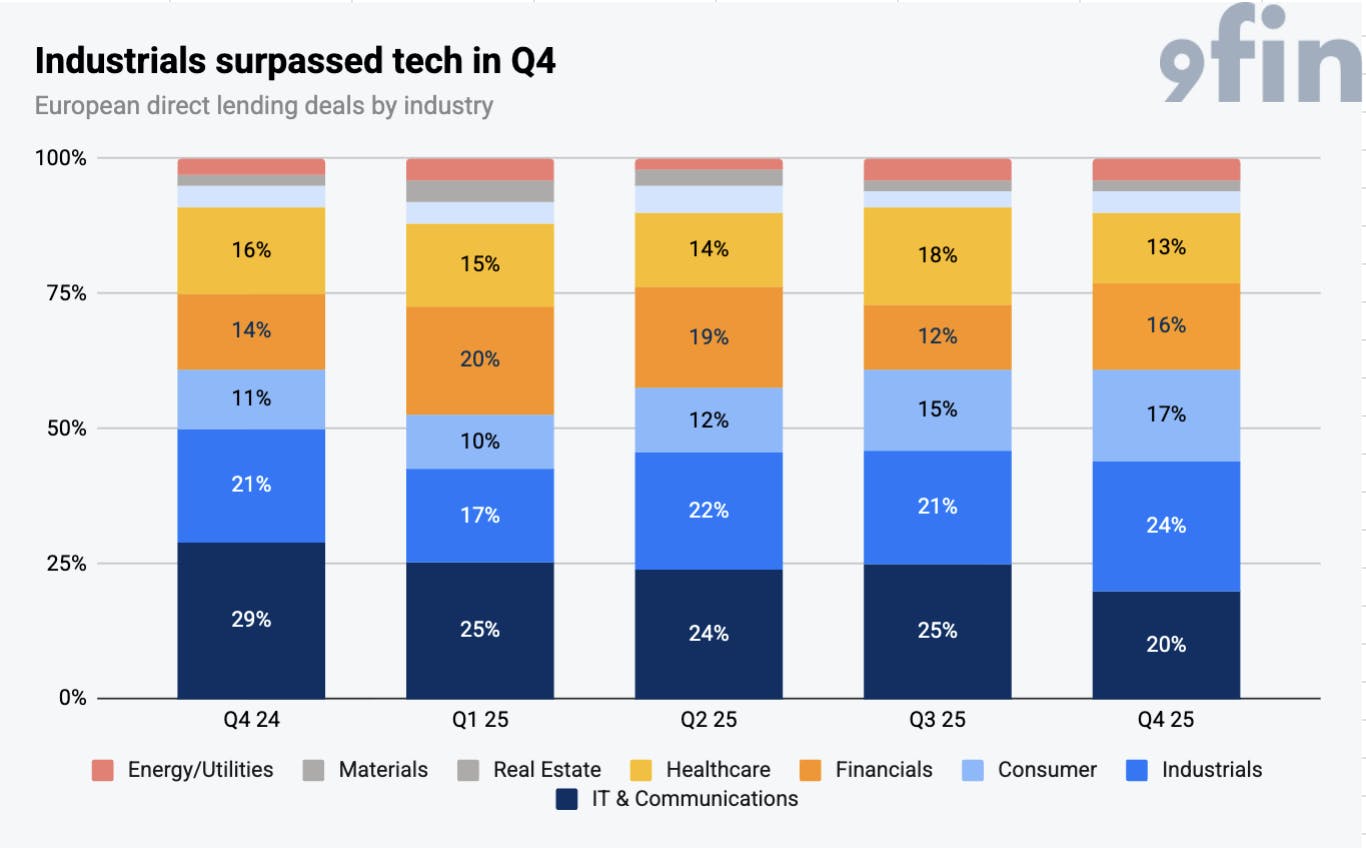
Direct lending appears to have shifted its focus in Q4 from its longtime mainstay industries of IT and communication services. These sectors accounted for only one-fifth of deals, the lowest level in several quarters.
Though one quarter does not make a trend, the shift in dealmaking from tech to industrials (which also includes business services) may reflect uncertainty around the impacts of AI and increased scrutiny around its long-term implications for software firms.
Lenders’ geographic focus also shifted in Q4. Southern Europe saw an increased share of dealmaking, with 50 deals closed compared with 29 in Q3 and 30 a year ago.
Muzinich led the region in deal count over the quarter, which included financing HIG Capital’s buyout of Italian aerospace logistics firm ALA.
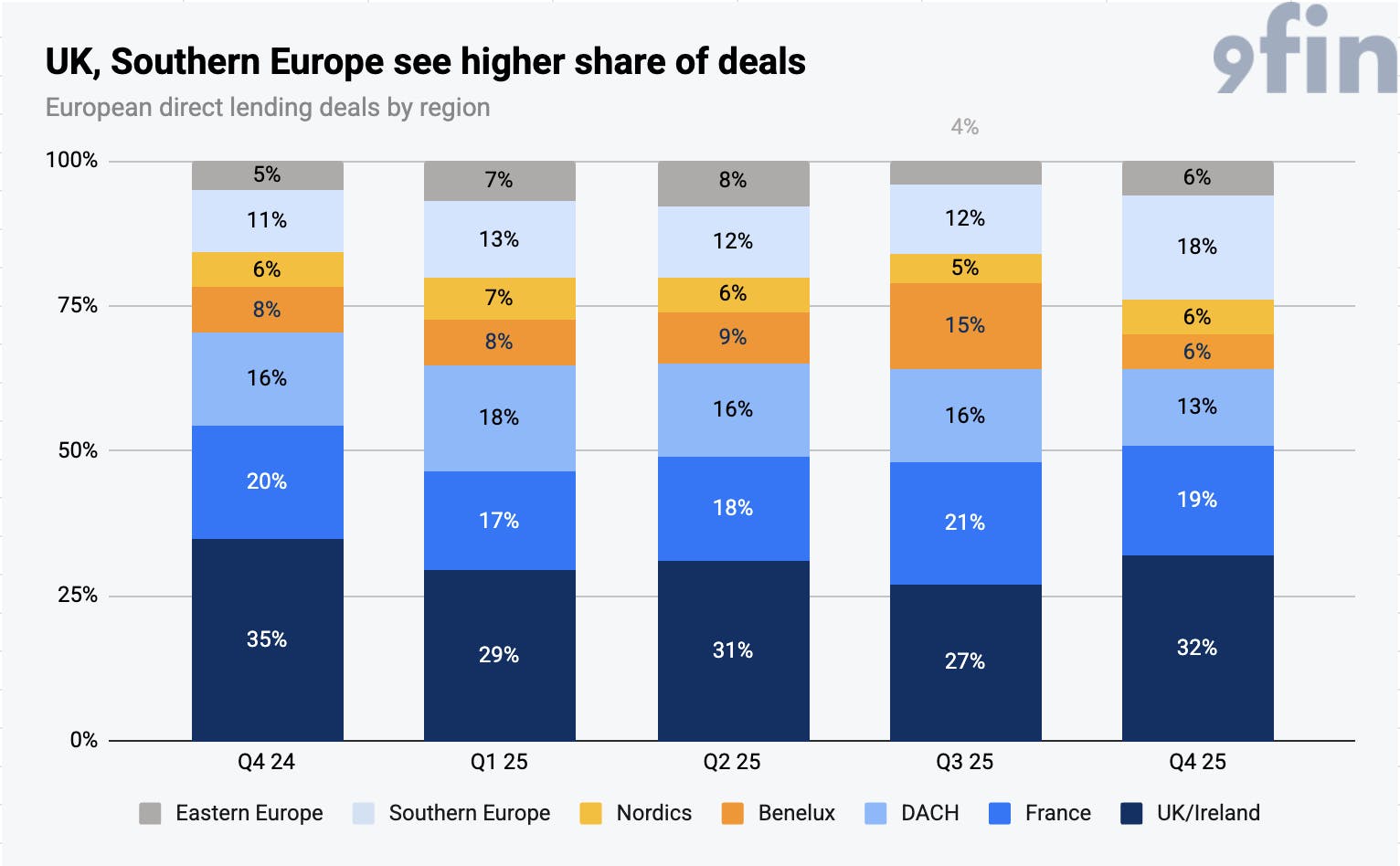
The UK and Ireland also saw increased deal flow quarter on quarter, up to 91 deals from 65 in Q3. This included the aforementioned JTC buyout, the largest private credit LBO of the quarter.
France, the Nordics and Eastern Europe also saw an increase in dealmaking quarter on quarter. In France deal count rose to 55 from 50, but was down from 56 in Q4 24. France was also home to the overall largest private credit deal of the quarter, a €2bn refinancing led by ICG for funeral services firm Funecap.
Nordic deal count rose from 13 in Q3 to 16 in Q4, but was down slightly from 17 in Q4 24, with no deals surpassing the €250m mark during the quarter. Eastern Europe similarly lacked larger deals over the quarter but deal count there rose to 17, up from 10 in Q3 and 14 in Q4 24.
Elsewhere, deal regional deal counts were flat or down year on year. Dealmaking in DACH was flat quarter on quarter at 38, and down from 45 in Q4 24. Benelux saw the largest declines, albeit from a frothy Q3. Deals in the region fell from 18 in Q4 from 35 last quarter and 23 a year ago.
Fundraising focus on Europe
Although it has been a relatively soft year for global private credit fundraising, Europe-focused funds netted a majority of the haul for the first time this decade. According to Preqin, Europe took a 57.4% share of European and North American private capital raised. This breaks with the early-2020s pattern of a dominant focus on North America.
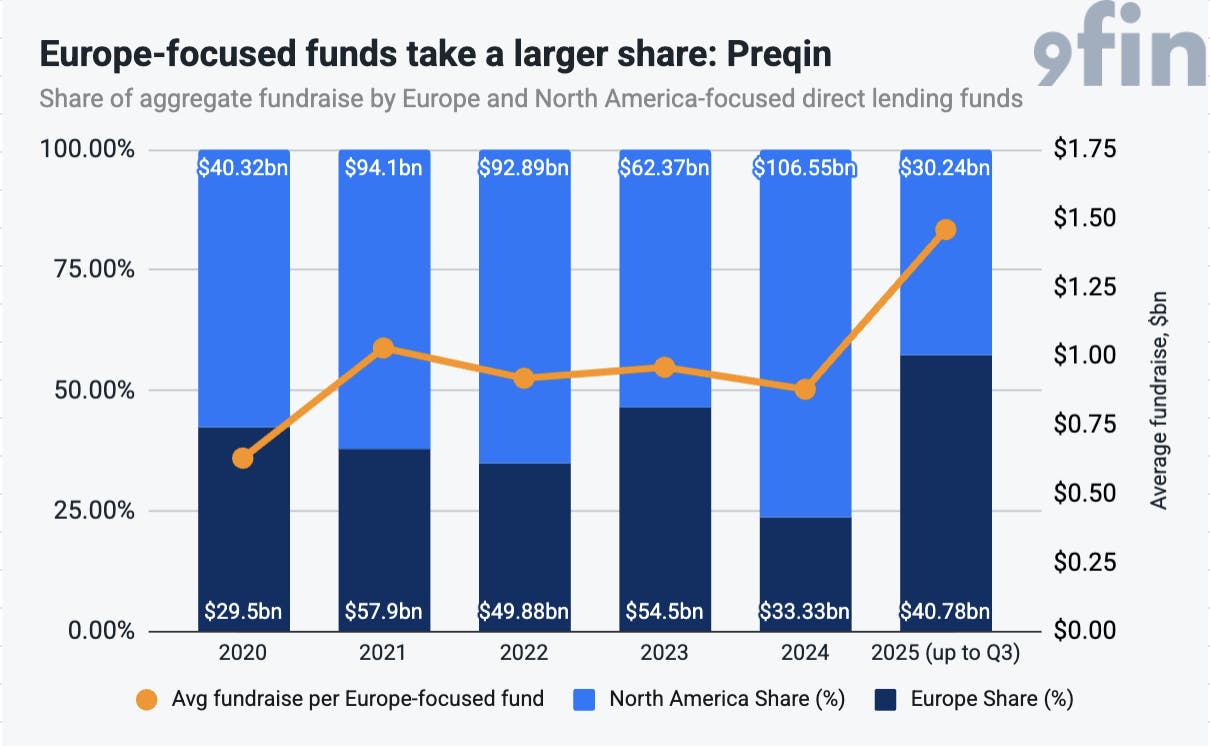
Even though European focused fundraising rose, it isn't quite Europe's defining moment. Combined fundraising fell from $98.4bn (Q1-Q3 24) to $71bn (Q1-Q3 25), so Europe's higher share is driven as much by North America cooling as well as by Europe’s relative resilience.
Still, it is an up year for Europe and it points to an increasingly common theme of investors reassessing their portfolio allocations.
Europe’s outperformance is being driven by larger raises, as opposed to more funds.
European-focused funds raised more capital with fewer funds than North America through Q3 (28 vs 39). Average capital raised per Europe-focused fund increased to $1.5bn through Q3 25 (vs $0.87bn in FY 24), consistent with the flight-to-safety dynamic with LPs concentrating commitments in an overcrowded market.
Meanwhile 2025 has seen a rise in private credit secondaries fundraising, as PC firms try to engineer their own liquidity, some headline raises in the area include Unigestion Secondary VI, Ares Credit Secondaries Fund and Pantheon Senior Debt III. Continuation vehicles are also becoming increasingly frequent, providing private credit firms with even more opportunities to benefit from a growing secondaries market.
Europe is picking up share as LPs de-risk amid heightened US volatility. Meanwhile, the rise in private credit secondaries and continuation vehicles shows how firms are increasingly leaning on the secondaries market to help manage liquidity.
The increased fundraising focus on Europe bodes well for deal flow going into 2026. Yet given the tight pricing and tough competition over the past year, we’ll be watching whether lenders can keep capital flowing out without sacrificing on deal economics.
For more more detail on how lenders stacked up, see our private credit league tables.
About the data
Data included in this report is collated from public sources, reporting by the 9fin editorial team and submissions from direct lenders. Available data may not reflect all market activity and, in some cases, historical data in the report have been revised as more information comes to light. To make sure your firm’s deals are included in our analysis and league tables, email private-submissions@9fin.com. For purposes of this report and our lender rankings, deals are counted based on the following criteria:
Criteria for inclusion
- Debt provided directly to corporate borrowers, whether secured, unsecured or asset-backed
- Financing provided by nonbank lenders through direct lending or credit opportunity funds, or similarly by separate direct lending divisions of traditional banks
- Financing provided on a bilateral basis or by a limited club of lenders at closing
- Unitranche, senior, subordinated or mezzanine debt, including subordinated debt provided by direct lending operations alongside the issuance of bank loans or public debt
- If an incremental financing, it will be considered a new deal if it is at least 90 days after the latest issuance by the borrower or if there has since been a change in ownership or sponsor. Otherwise, it will be considered an additional tranche of the existing deal.
Exclusions
- Amendments, extensions, or repricings of existing facilities without new capital commitments
- Drawdowns of existing facilities (deals are counted based on the date capital was committed)
- Syndicated loans or debt provided by direct lenders as part of a bank-led syndication
- Secondary trades of private debt
- Participation in SRT transactions
- Participation by CLOs or special situations funds
- Loans with tenors of less than 90 days
- Add-ons within 90 days of original issue
Definition of large cap — debt packages structured off more than €50m EBITDA or totalling more than €250m total debt;
Definition of mid cap — debt packages structured off €10- 50m EBITDA or totalling €50-250m total debt;
Definition of small cap — debt packages structured off less than €10 EBITDA or totalling less than €50m total debt.