Private credit loves a crisis. Or at least, that's what we’ve been trained to believe. Every time volatility picks up, the same assumption resurfaces: banks retreat, the syndicated market shuts, and direct lenders turn dry powder into market share.
But the reverberations in the credit market following the war in Iran haven’t led to that narrative repeating. Private credit is still aggressive, and sponsors are still comparing options and, more to the point, banks are still underwriting.
Pricing may be a little wider and everyone is a little more nervous, but not nervous enough to stop doing deals.
In the latest examples of the loan primary market being open, a number of opportunistic bank loans were launched this week, despite tensions escalating in the Gulf over the weekend. This included Sketchers’ repricing and Cooper Consumer Health dividend recap.
Banks are also willing to compete with private credit funds for quality assets.
“Despite market uncertainty, banks are showing conviction for strong, resilient European upper mid-market credits in competitive sale processes, in some cases offering to underwrite 100% of the debt package,” said Aude Doyen, co-head of Lincoln’s Capital Advisory Group in Europe.
Crucially, there's been no repeat of the Liberation Day dynamic, when private credit snapped up several high-profile deals that would normally have gone through the BSL market — including KKR's acquisition of Swedish pharmaceutical company Karo Healthcare and the carve-out of Spanish online classifieds platform Adevinta Spain.
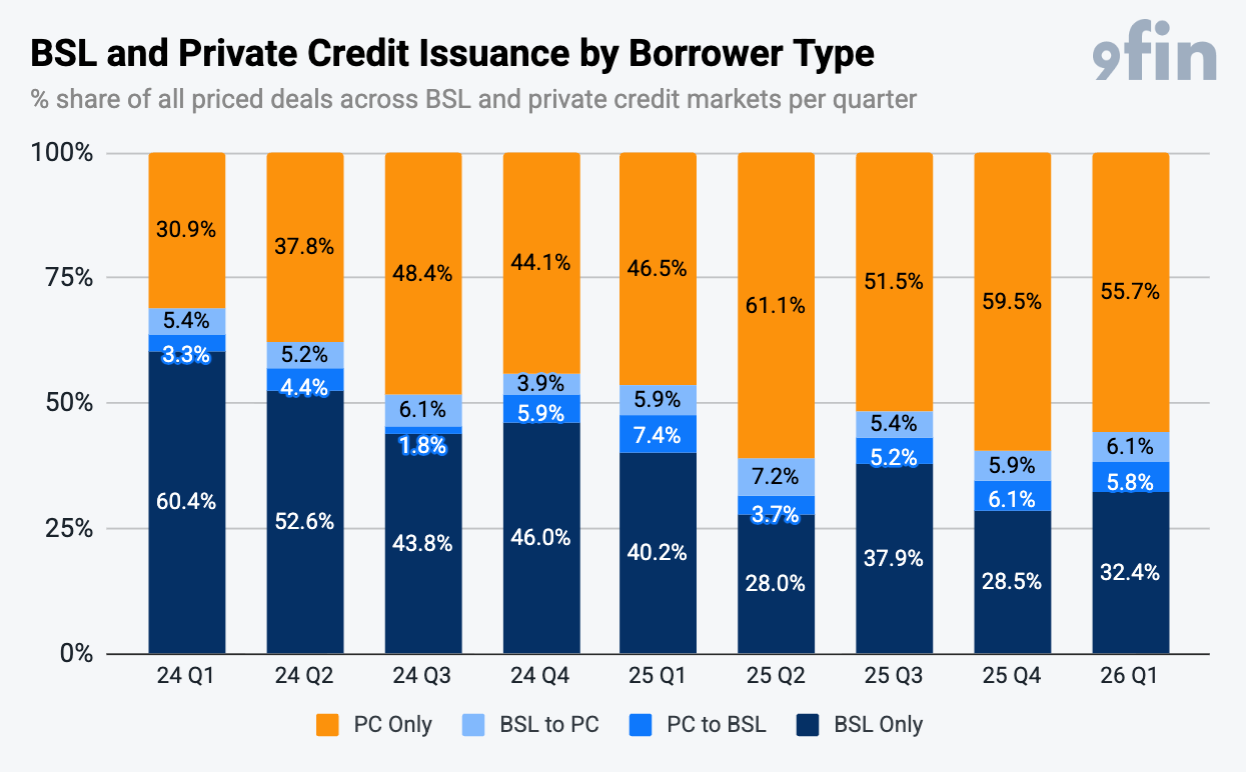
If we look at the data for Q1 for all the priced deals across BSL and private credit markets tracked by 9fin, private credit-only deals accounted for just over 55% of the market, while BSL-only deals made up around 32%. One caveat worth noting is that many of these BSL deals were underwritten late last year, so the figure doesn't show the full picture of current bank appetite. But it does give us a sense of the direction of travel.
If we look at only those large-cap loan deals (deal size of €250m or more) where private credit funds often go head-to-head against bank financing then Q1 26 could not have been more balanced with each grabbing a 50% market share. Contrast that to the aftermath of Liberation Day when deal flow was tipped in favour of private credit at 65% (see second chart).
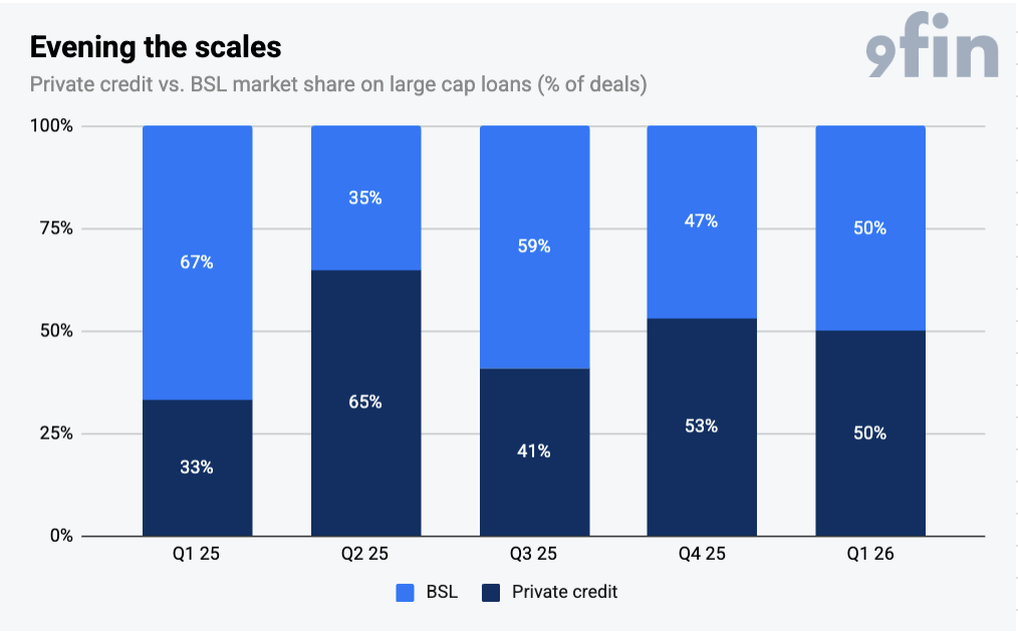
In Q1 this year, both the BSL and private credit market issued 68 financings each, according to 9fin data
Playing the long game
The balanced equation between private credit and syndicated loans comes amid what has been a relatively slow primary loan market since the Iran war began. But even before that issuance had been dominated by repricings with only a smattering of M&A for quite a while.
The post-Covid window, when everyone convinced themselves that everything was going to be amazing was a long time ago. Since then, sentiment has been quietly deflating. Sponsors and lenders have been transacting, but nobody has been doing it under the illusion that conditions are particularly supportive.
“It is not like everything’s great, and then the Iran conflict happened, and everything crashed to earth,” said a leveraged finance lawyer. “I think we’ve been in a transactionally subdued environment for a long time.”
Like the stock market, bankers seem to be betting on TACO — that US president Donald Trump will back down in his stand-off with Iran and a resolution will emerge. Either that or market participants have learned to tune out the noise.
The over-riding belief though is that the primary loan market will click back into gear. Two European loan PMs told 9fin that they had an optimistic outlook on the loan market for the rest of this year. But they both caveated that this is on the assumption that the Strait of Hormuz re-opens and the Iran war ends in the coming weeks.
Relying on US foreign policy is not the most comfortable position to be in given the unpredictability attached to this. But banks are willing to be patient.
“I think the willingness from banks to underwrite and sit on debt for a little longer is because the market may sometimes have a window where there’s no issuance, but it’s not going to last long,” said a leveraged finance banker. “The market will come back, so banks are pretty comfortable underwriting.”
“This market is actually a bit of an oxymoron,” said a second LevFin banker. “Rates are up, but spreads are tighter. So financing is still available for good companies in the market.”
Automotive coating supplier BASF Coatings’ €2.02bn dual-currency TLBs due 2033 was priced 75bps tighter than initial price talk and drug capsules manufacturer Capsugel also priced its €1.58bn dual-tranche TLB & SSNs at the tighter end of the initial price talk.
But the comfort has its limits. The real anxiety isn’t about signing deals today — but the syndication in a few months time, when the impact of the Strait of Hormuz choke starts showing up in earnings.
“I am worried that people are asleep at the wheel and it’s going to get worse,” said the second LevFin banker. “Deals that I have to sign up for today, but I can’t sell until September. That worries me.”
For sponsors weighing up their options, the relative value calculation hasn't really changed.
“In Q1 and April, financing appetite persisted against a backdrop of continued headlines on AI risk and the conflict in the Middle East. Spreads on European deals moved modestly, while the gap between BSL and direct lending remained broadly in the 125-175bps range,” said Doyen.
European private credit has now hovered at around 500bps for four straight quarters, according to 9fin data, marking a sharp shift from the recent historical peak of 637.5bps in Q3 24. On the other hand BSL pricing in Europe has continued to tighten, with median pricing falling to 280bps in Q1 26. The gap looks wide, but the data includes smaller deals that would not typically compete in the BSL market.
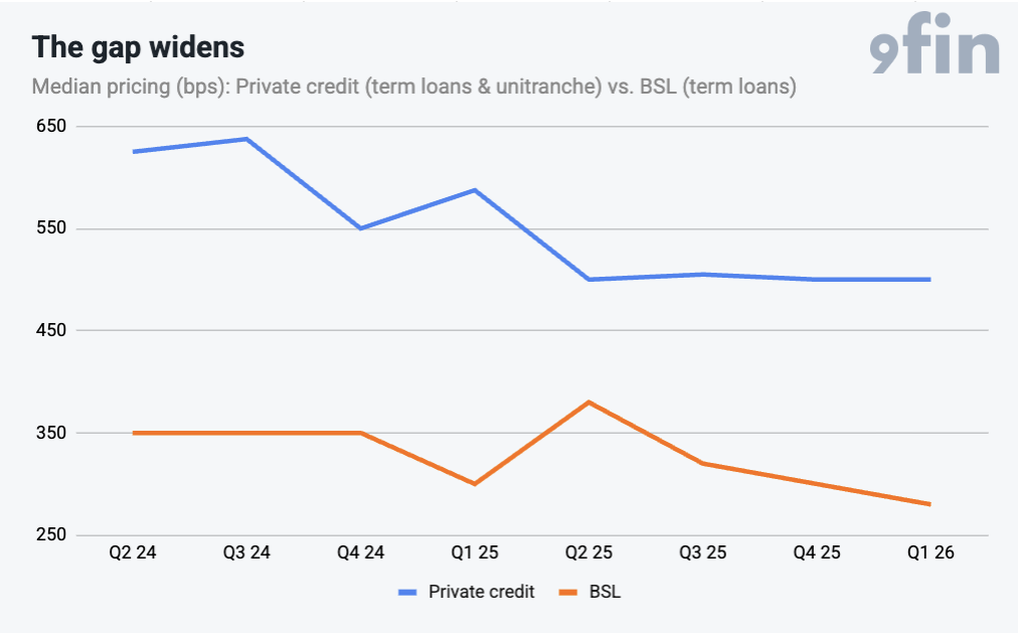
Evolution of the private credit/TLB dynamic
There are a couple of live situations were banks and private credit funds are competing, namely the French sales processes for CLS and Evernex.
An M&A lawyer claims that ”private credit is effectively becoming the driving force of PE deals, particularly in the mid-cap and high mid-cap areas”.
The current balance between bank financing and private credit suggests neither market has gained a decisive edge. Bank pricing has not widened enough to make private credit the obvious choice for sponsors, while direct lenders are still under pressure to deploy rather than stepping back because of supply constraints.
Private credit is also dealing with problems of its own: the software shock is creating real uncertainty for direct lenders with heavy technology exposure. To rebalance their portfolios away from SaaS, private debt funds are targeting business services and industrials deals with aggressive debt packages. For banks circling those businesses, dealmaking will become tougher.
A 50/50 split between private credit and bank financing means we’re now at the point where the direction PE sponsors take is effectively a flip of the coin.
This competition may be driving the next stage of market evolution: banks are willing to offer attractive syndicated financing and keep the primary loan market open even during periods of volatility. Meanwhile it's clear that private credit is an all-weather product and not limited to windows of opportunity. And that means the tussle between banks and funds is becoming persistent, rather than seasonal.