In April 2025, Jake Stokes was picking up his five-year-old son from his KinderCare Education daycare center in Fort Wright, Kentucky, when a teacher pulled him aside. His son had been involved in a minor altercation with another child, but the staff assured him the boy was OK.
Stokes didn’t think much of it at first. Kids get into minor scrapes all the time, and he figured if it were anything serious, the school would’ve called him immediately. But then he noticed something odd: his son was sitting indoors wearing sunglasses, something the boy never did.
When he took off the sunglasses, he saw that his son’s right eye was red and visibly swollen. The staff then told him some mulch had gotten into the boy’s eye during the scuffle, but insisted there was no need to panic.
“I thought it must not be anything since I trusted their judgment,” Stokes said. “I gave them the benefit of the doubt.”
But the pain didn’t stop at home. As his son cried in agony, Stokes rushed him to a doctor, who diagnosed the boy with a scratched cornea. The doctor warned that if the scratch had gone any deeper, the five-year-old could have been partially blinded.
“That’s a big deal,” Stokes said in an interview with 9fin. “Why was I not told about this?”
Stokes immediately pulled his son out of the KinderCare facility. The move had major implications — Stokes is a student at Northern Kentucky University, so he had to scramble to balance child care with his college classes — but he felt he had no choice.
His experience is not unique. This ordeal is just one example of a growing pattern of similar failures across the KinderCare network, according to news reports and court records.
The list of alarming incidents spans the country: in April, a three-year-old escaped a Spokane, Washington, KinderCare and darted into a busy street. Earlier in October 2025, a four-year-old was found wandering through Las Vegas traffic after slipping out of another KinderCare facility.
There were also allegations of outright mistreatment. A viral video shared on social media last August shows a Florence, Kentucky, KinderCare teacher screaming at a child, and mother in Pittsburg, California, testified at a local council meeting in May 2025 that her five-year-old twins were abused by staff at their local center. Just last month in Raleigh, North Carolina, a KinderCare worker was indicted after being accused of fracturing a four-year-old’s leg.
Debt repricing reward
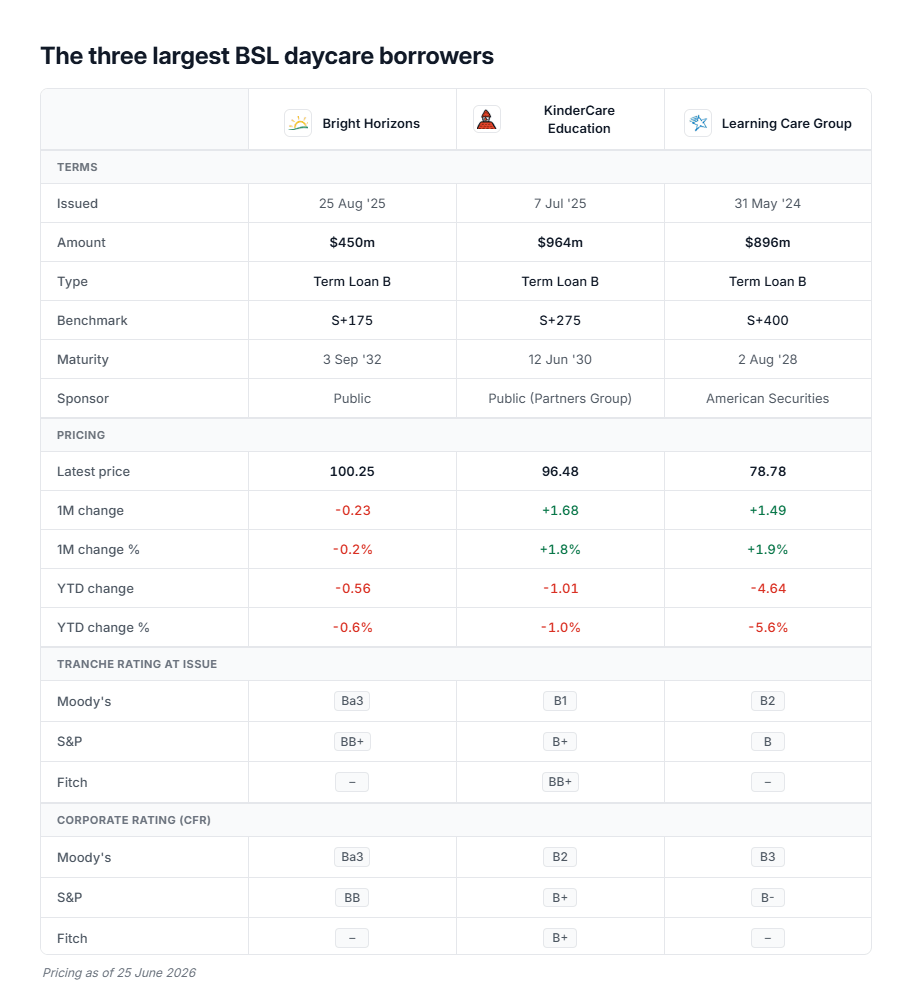
Over this same period, KinderCare scored a 50bps reduction on its loan margin, repricing its TLB due 2030 from SOFR+325bps to SOFR+275bps in June 2025. The loan priced at par, but is now quoted roughly 3.5 points down at 96.48, according to 9fin data.
KinderCare was founded in 1969 and grew under several private equity owners to become the country's largest child care provider, spanning more than 1,500 centers across the country. Though it went public in 2024, Partners Group — which acquired KinderCare in 2015 — remains its controlling shareholder.
And KinderCare is one of a growing number of for-profit daycare chains that are either currently backed by, or grew rapidly under, private equity: including Learning Care Group and Bright Horizons (read on for a more detailed list).
Investors have poured billions of dollars into this industry over the last two decades, turning these operators into dominant players. While proponents contend they’ve been able to dedicate more resources to providing higher-quality care, others argue they’ve instead focused on cutting costs at the expense of children’s safety.
But with an industry filled with small, local providers and a near constant demand for child care in the country, it’s easy to see what attracted private equity to the market in the first place.
“It’s a highly fragmented industry,” Kathy Ligon, founder and CEO of HINGE Early Education Advisors, which consults on mergers and acquisitions in the industry, told 9fin. “There was an opportunity for some consolidation.”
PE moves in
Private equity first turned its attention to the industry just after the Global Financial Crisis, and its footprint has grown steadily ever since. As of 2026, private equity firms own eight out of 10 of the largest daycare chains.
The corporate takeover began in earnest in 2008 when Bain Capital bought Bright Horizons for $1.3bn, eventually taking it public in 2013 and exiting its remaining stake by 2018. Other firms quickly followed the money — American Securities acquired Learning Care in 2014 for an estimated $650m to $700m, and Partners picked up KinderCare for $1.5bn in 2015. Then, other chains were eventually snapped up, with Roark Capital acquiring Primrose Schools, Golden Gate Group buying the Learning Experience, in addition to Sycamore Partners’ takeover of Goddard Systems.
Source: 9fin
Investors saw opportunities for rollups thanks to a scattering of small operators spread across the country and a supply-demand imbalance for daycare vacancies. One recent study estimated a 28% gap between demand for children under the age of five and existing spots.
Ligon, who has 40 years of industry experience, maintains that private equity’s move into child care has been a positive development. The industry is highly regulated, so a well-funded chain has the ability to build the infrastructure necessary to navigate that. More importantly, they are often the only institutions that can keep locations open in some areas.
“The benefits that I saw are better pay for staff, better benefits for staff and increased investment and services for the curriculum and facilities,” Ligon said. “You have to have a certain mass to get to a financial situation where you can even afford to operate in a way that brings true quality and access to families.”
A spokesperson for KinderCare echoed Ligon’s view. They said the ability to have dedicated teams focused on licensing, subsidiary programs and regulatory requirements allow “our centers leaders and teachers to focus on what matters most — supporting children and families.”
“Our scale allows us to invest in teachers, curriculum and family support in ways that benefit children directly,” the spokesperson said, adding that it invests in quality standards that often go beyond state requirements. A spokesperson for Partners Group declined to comment.
And yet, private equity’s encroachment into the childcare space has faced criticism from lawmakers, researchers, former employees and parents. They are concerned that the model of stacking companies with debt and cutting costs to extract as much profit as possible could spell disaster for an industry that serves such a vulnerable population.
“There is no other model that has as many incentives to maximize profits over any other objectives,” said Audrey Stienon, industrial policy program manager at antitrust nonprofit Open Markets Institute, whose research focuses on the rapid expansion of private equity in child care. “We want to make sure that every single actor that goes into space is also prioritizing other objectives … [that] these businesses do more than just make money.”
American Securities did not return a request for comment. A spokesperson for Learning Care referred questions to the Early Care and Education Consortium, a trade group for private equity-backed daycare centers, who shared a response to Stienon’s study from its executive director, Radha Mohan.
Mohan’s response argued that the problem isn’t about who owns the site but that “families are being asked to shoulder the full cost of delivering high-quality early care and education without sufficient public support.”
“The real policy challenge is how to design funding and regulatory frameworks that allow all providers — nonprofit, public, and for-profit — to pay educators as the skilled professionals they are while making care more affordable for working families,” Mohan wrote.
Critics, however, point to a series of abuse allegations and violations at for-profit chains across the country. Former workers said they’re filled with improperly trained staff and unable to maintain the required ratio splits between teachers and children in the classroom. Meanwhile, staff struggle with low pay, leading to a revolving door of employees.
“They have to squeeze every cent out of families and pay their workers as little as possible while cutting corners with quality/materials, constantly choosing profits for shareholders over quality education and services,” a former executive director of a Learning Care Group center in California wrote in a message to 9fin. “As a director, I was expected to do at least three people’s jobs, never able to take breaks or time off.”
This has now caught the attention of state governments. Massachusetts passed a law in 2024 that put guardrails on the use of public funds for centers operating more than 10 sites in the state.
And there could be more on the way. In March, Senator Jeff Merkley (D-Oregon) launched an investigation into KinderCare and Learning Care, seeking financial records, information about their ownership structures and tuition cost trends to assess if owners prioritized profits over the health and safety of children in these centers.
“Ensuring working families can access safe and affordable child care is paramount to building out the middle class and making it easier for families to get ahead,” Merkley said in a press release announcing the investigation. “Unfortunately, private equity firms have increasingly brought their playbook to essential care industries — including child care — buying up independent providers, rolling them into large chains, and prioritizing investor profits over the well-being of the families and communities that depend on these services.”
The KinderCare spokesperson said the company was working with Senator Merkley’s offices, and that it welcomed “the opportunity to provide information about our operations, quality standards and commitment to children and families.”
While the government has stepped up scrutiny of private equity’s role in the industry, Ligon credits these firms with driving a massive increase in daycare standards. Because of this, she worries about the unintended ramifications of enacting laws that would restrict them.
“It feels like since the years we’ve had private equity investments, we’ve strengthened quality, we've strengthened our workforce,” Ligon said. “My fear is we get to the place where we limit the very groups that are investing in increased accessibility for families and, in my mind, affordability and quality.”
When things go wrong
There have been some high-profile safety failures at some of these for-profit centers.
Bright Horizons is currently facing a lawsuit in the UK over a harrowing scandal at a London nursery. The legal action follows the guilty plea last year of a worker who admitted sexually abusing children at the facility for years, even filming the abuse on company issued iPads. The suit claims the center dismissed parents' concerns over his behavior.
In New York City, three workers at Bright Horizons’ Columbus Circle location were arrested in July and charged with abusing toddlers, including taping their mouths shut and spraying them with bleach. A New York Times investigation found that Bright Horizons locations around the city racked up nearly 40 complaints from July 2024 to July 2025 over allegations of injuries, workers losing children and improper discipline.
As part of a settlement with New York City, Bright Horizons closed the Columbus Circle location and agreed not to open new facilities across the five boroughs in 2026. A spokesperson for Bright Horizons declined to comment.
In Wisconsin, KinderCare had some of its licenses for centers revoked in 2024 after violations for lack of attention given to children, staff members who were not qualified to teach still being in classrooms, and failures to file required reports after children were injured. And last year, a KinderCare in Indiana was put on state probation after investigators found allegations of abuse.
“Nothing is more important than the health, safety and development of the children in our care,” the KinderCare spokesperson said. “We take concerns seriously and continuously invest in training, quality and accountability across our organization.”
These abuse allegations have been on the radar of some investors. KinderCare is facing a proposed class action lawsuit accusing the company of misleading investors when it went public in 2024 by downplaying the allegations of child abuse in its IPO filings.
Cutting costs on care
Stienon said it’s been difficult to track whether these types of for-profit centers have more instances of abuse or violations than locally owned ones. But she argued they carry an inherently higher risk given the private equity playbook of cutting costs — especially on labor — to turn a profit.
“The quality of child care is directly dependent on the well-being of the workers,” said Stienon. “So this tendency to push down on labor costs, because labor costs are the greatest expense for care providers, has a direct impact on the quality of care.”
A former Learning Care employee in Kentucky said she only made $15 an hour, and her center was so understaffed she could not find time to take breaks. It was her first job in the industry and she felt completely unprepared.
“I started with no training, I literally got thrown into a classroom,” said Aubrey Dabney, who worked at Learning Care’s La Petite Academy for 10 months last year. “You’re supposed to shadow with another employee before you go into a room.”
She said Learning Care provided some training videos, but she was supposed to watch them on her own time without getting paid.
The understaffing at her center meant she was often the only teacher in a classroom with up to 20 children, much higher than Kentucky’s required 1-to-5 to 1-to-15 ratio, depending on the age group, for children 5 and under.
“It was more like you were policing the kids than getting to be a teacher,” she said.
The former Learning Care director, who worked there for five years, said the company often worked “caring teachers to death,” who only stayed on because they were desperate to keep their health insurance.
Dabney said many of the caring teachers at her site didn’t last long, so they often “hired anyone who could pass the background check.”
“There were a lot of people who would go to class and be on their cellphones, because the directors were less in the room and more on the computer doing meetings,” she said.
A spokesperson for Learning Care said that every staffer is required to complete a week-long orientation led by a trainer before going into a classroom, along with additional in-person training days throughout the year. They added that the sites “strictly adhere” to local regulations.
“We believe every team member deserves to feel supported from day one and beyond, which is why we've invested in an expert-created teacher training program that sets a high bar for the industry,” the spokesperson said in a statement. “We remain committed to investing in the training, oversight, and support structures that hold every school accountable to the same high standard.”
A mother who briefly sent her son to an Indianapolis, Indiana-based KinderCare in 2021 said she noticed a clear difference in training for teachers there compared to the privately-owned center her son attended after.
Her son, who was four at the time, is autistic and came home every day saying he was upset he didn’t get to use the bathroom at the KinderCare facility. Staff wouldn’t allow him to go to the restroom unless he went in a large group, and he would cry because the other children were watching him.
The staff wound up calling Child Protective Services on her, claiming they noticed various issues that the CPS agent found no evidence of. She pulled her son out of the facility immediately, eventually moving him to a new center.
“I do feel it was a lack of training, lack of compassion, dislike for their jobs and the environment,” she wrote in a message to 9fin.
Stokes was also shocked by the difference in protocol at his son’s new daycare, also a privately-owned center. When his son sustained a minor injury at the new center, staff members called Stokes immediately, gave a thorough account of the incident, and allowed a family friend to check on the boy.
By the end of the day, a full incident report was ready — even though his son only needed a couple of Band-Aids.
Due process
Meanwhile, at the Fort Wright-based KinderCare, Stokes only received a report three days after the incident happened.
“The lack of procedure made me suspect that something went wrong on their part,” he said. “They became very defensive.”
Stokes attempted to sue the center, but a Kenton County judge ultimately dismissed the case over a procedural issue stemming from Stokes’ decision to represent himself. A spokesperson for the Kentucky Courts did not respond to requests for comment on the reason for the case’s dismissal.
The KinderCare spokesperson said educators undergo onboarding and complete the required state training before getting into a classroom. There’s also ongoing professional development throughout the school year — including in-person workshops, monthly staff training and specialized programs — and KinderCare also pays teachers to “earn nationally recognized credentials.”
“Nearly 90% of KinderCare centers are nationally accredited voluntarily — far exceeding the industry average — and we continuously evaluate our programs, practices, and outcomes to ensure we're delivering the high-quality care and education families expect,” the spokesperson said.
One parent of a former KinderCare student in New York said his attempts to take legal action against the company have been an uphill battle. Contingency-fee attorneys told him the projected payout wasn’t substantial enough to justify taking the case, and he cannot afford to pay a lawyer out of pocket.
He has also faced constant roadblocks from KinderCare while attempting to gather information about the incident involving his daughter. He declined to share the details of the incident with 9fin.
“They’re very aware of knowing how to shut things down,” he said. “Downplaying each and every situation, no matter how big it is.”
“If you want any information, they’ll direct you to go get a subpoena,” he added. “You hit a roadblock.”
The KinderCare spokesperson said that “when issues arise, we work directly with families, take accountability and make improvements where needed. Continuous improvement is central to how we operate.”
Understaffing impact
Dabney said that chronic understaffing at her Learning Care took a double toll, leaving staff burnt out and forcing the facility to regularly cut its hours and close early. There have also been reports of a KinderCare center abruptly closing for a day due to a lack of staff.
Aside from leaving parents scrambling to figure out child care, the closures put more pressure on the teachers, who often only get paid when the center is open, Stienon said.
“If you’re trying to maximize profits, you send your teachers home,” Stienon said. “For the staff, your wages are super unpredictable; it’s going to change day-to-day.”
Stokes said he was initially attracted to KinderCare because of its convenient location, but also because its tuition was cheaper than other options in the area.
“Their rates are cheap and affordable, but I think that’s just the double-edged sword,” Stokes said. “You have teachers who don’t have any training.”
Stienon added that cheaper tuition is often a mirage. Private equity-backed centers often tack on surprise fees, forcing parents to pay extra for meals, field trips, or even the use of specific rooms within the facilities.
Still, the low sticker price remains a huge draw as child care costs continue to soar, forcing families to shell out an unsustainable portion of their household income just to secure a spot.
While data on child care costs in the country is incomplete, a report from the nonprofit Child Care Aware of America found that the average cost of child care increased 23% from 2021 to 2025, currently $13,841 annually. (The report only tracked data from 47 US states.)
Pricing has largely kept pace with inflation, but many families exceed the federal affordability benchmark of spending more than 7% of their income on childcare. On average, married couples spent 10% of their median income on child care last year, while a single parent paid 33%, according to the study.
Falling state support
Both proponents and critics of private equity’s expansion into the space agree that the root of the problem lies in the lack of government funding to help families subsidize child care costs.
Despite the supply-demand imbalance, some providers have been struggling, Ligon said. In January, the Trump administration froze child care grants in five states. Meanwhile, operators are shouldering higher construction and labor costs, while being unable to raise tuition rates to cover those expenses, Ligon added.
“We’re seeing companies make less money because you can’t balance the new cost of care with the affordability for families right now,” she said.
Those pressures have started to show on operators’ balance sheets. Learning Care has grappled with weaker-than-expected enrollment rates — which management blamed on families gravitating towards lower-cost child care options — and high leverage, according to S&P, which revised Learning Care’s outlook from ‘stable’ to ‘negative’ on 5 June.
In March, Learning Care lenders formed a cooperation agreement with Gibson Dunn ahead of its $896m term loan B’s 2028 maturity, as 9fin previously reported. Quotes on the TLB are currently at 78.78, roughly four points lower versus the beginning of 2026, according to 9fin data.
Fitch downgraded KinderCare’s secured debt to BB/RR2 on 17 April, citing weak enrollment, softer demand and ongoing competition. KinderCare saw its $964m TLB due 2030 fall into the low-90s after the downgrade, but indications on it returned to near par by June, according to 9fin data.
There haven’t been any major bankruptcies for US daycare chains, but researchers studying the sector have pointed to the 2014 collapse of Dutch daycare provider ESTRO as a cautionary tale of what happens when a highly leveraged operator falls into trouble.
The daycare provider went through several leveraged buyouts until it filed for bankruptcy in 2014, with its assets subsequently acquired by HIG Capital for a mere €6m, followed by a swift rebranding to Smallsteps.
But in the process, it shed more than one-third of ESTRO locations and was able to avoid fulfilling its “legal social obligation” to more than 1,000 laid-off workers, according to a study by the University of Amsterdam.
“The parents, children and workers in the over one hundred former ESTRO-locations that were closed down in the aftermath of the bankruptcy were, without doubt, the biggest losers from this sorry story of serial plunder,” the paper said. “The owners, on the other hand, have mostly skillfully avoided any losses.”
The paper found that ESTRO’s CEO and CFO had pocketed “special bonuses” of €41,000 and €33,000 two months before the bankruptcy. Consultants and advisors were paid €23m in fees during the restructuring.
These potential dangers have prompted states to implement guardrails against the industry. Aside from Massachusetts, New Jersey implemented a 2.5% margin cap on for-profit daycare programs, while Vermont passed a law capping tuition hikes by providers and requiring ownership disclosures to be eligible for state funds.
The KinderCare spokesperson declined to comment on whether state legislation has impacted any of its expansion plans, but said that families are looking for more daycare options.
“More than half of Americans live in areas with an insufficient child care supply, and parents consistently tell us they want more options, not fewer,” the spokesperson said. “We believe public investments in child care should prioritize expanding access, supporting quality, and giving families meaningful choices so they can find the program that best meets their needs.”
Colorado moved to pass a bill last year that would’ve required daycare centers give parents and teachers a 60-day notice about layoffs or enrollment changes if a site gets acquired by a private equity firm. The bill ultimately died in the State Senate in April 2025.
State Senator Kathy Kipp, a sponsor of the Colorado bill, said private equity-backed chains launched fierce lobbying efforts to squash the bill. But she stuck with her support because she saw the effects of their ownership of these centers.
“We had at least one colleague who lost his child care with almost no notice,” Kipp told 9fin.
And losing just one location could be detrimental to children and families, Stienon said. As it stands, KinderCare’s management noted during its Q1 26 earnings call that it expects to have a “higher number of center closures than usual” this year as it grapples with enrollment declines — a factor which continues to be a “primary pressure point on the business”, said CEO John Wyatt.
But when private equity-backed chains dominate a market, the sudden collapse or closing of one center can trigger a crisis — similar to some private equity-owned hospital systems across the country.
“Once you create these chains, you’re thinking only about the money and you close centers that don’t make money,” Stienon said. “For the community that’s dependent on one center, that’s just devastating.”