
Q2 2026 saw its fair share of trials and tribulations for the CLO market, including tremors from the “SaaS-pocalypse” earlier in the year, the intermittent warfare in Iran with its attendant oil price shocks, and assets tightening faster than liabilities raising familiar questions about the CLO arb.
What the CLO market has proven by now, is that it can always find a way to get business done. Q2 saw 245 US BSL CLO deals, up from 207 in Q1, and in Europe, deal flow stayed steady at 72 pricings, down slightly from 75.
Although attention may have shifted from new issues to repricings, that left plenty of mandates for law firms to compete for.
The rankings
Following a year of upheaval and cross-firm moves, new firms (if not always new lawyers) have established themselves at the top of the league tables. For an excel copy of the tables please click here.
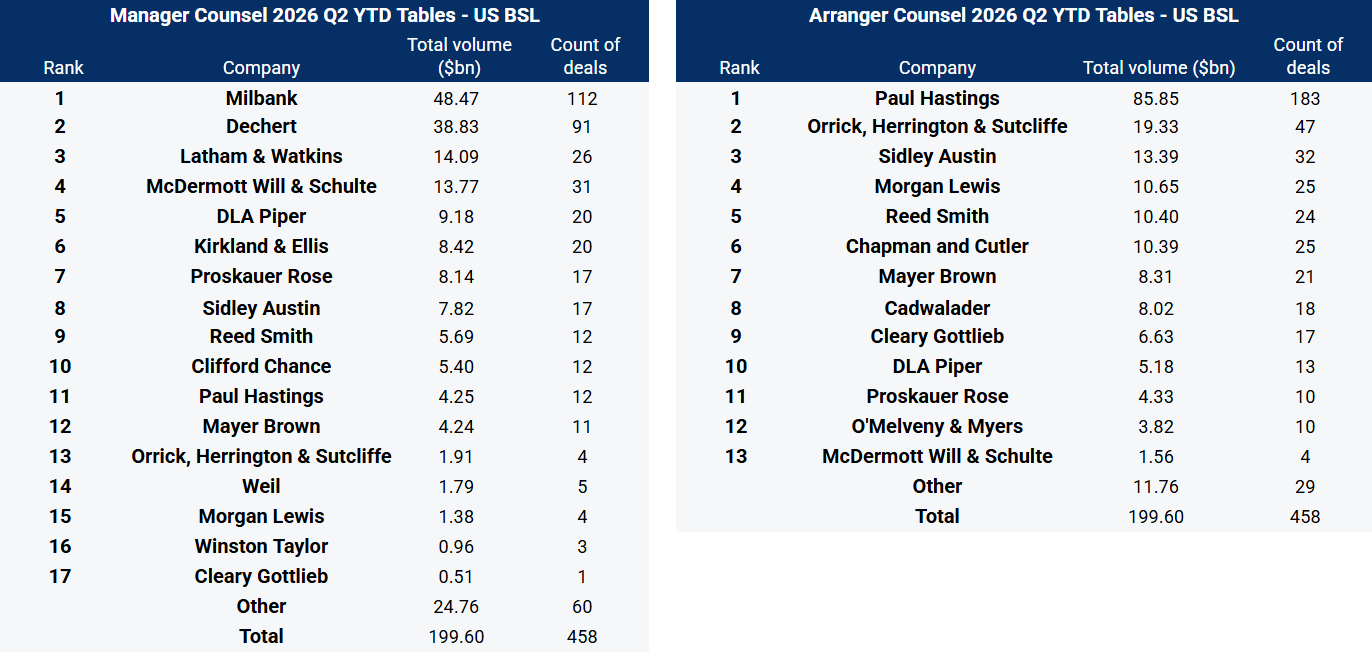
In the US BSL market, the top two firms in the manager counsel rankings, Milbank and Dechert, have pulled away from the rest of the pack, taking up nearly half of the market share by the half way point of the year. Latham & Watkins has overtaken McDermott Will & Schulte to take a $320m lead over the latter in third place.
In the arranger counsel rankings, first place remains something of a constant. As of the end of Q2, Paul Hastings has worked on 183 deals, which is a 43.1% market share. Orrick, Herrington & Sutcliffe and Sidley Austin, after neither firm being in the top five in 2025, have cemented second and third place for the second quarter in a row.
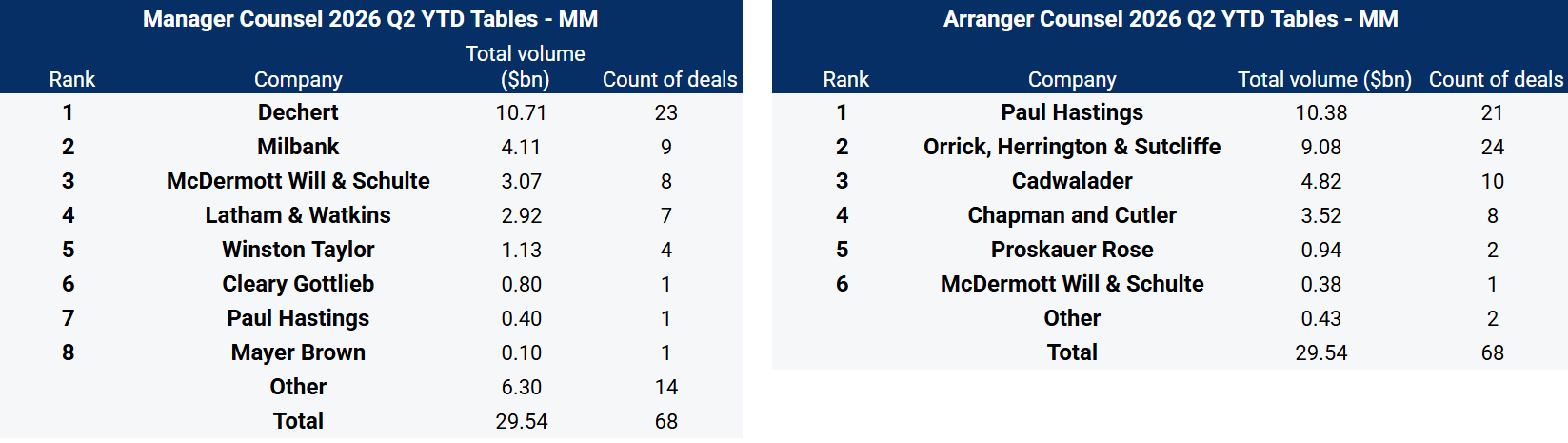
In the private credit CLO league tables, Dechert maintains its impregnable position at the top of the manager counsel tables, with Milbank holding onto second place, but in a reverse of the BSL space McDermott has moved above Latham & Watkins to take third place. Paul Hastings has overtaken Orrick in terms of deal volume in the arranger counsel tables, although the latter has worked on more individual deals.
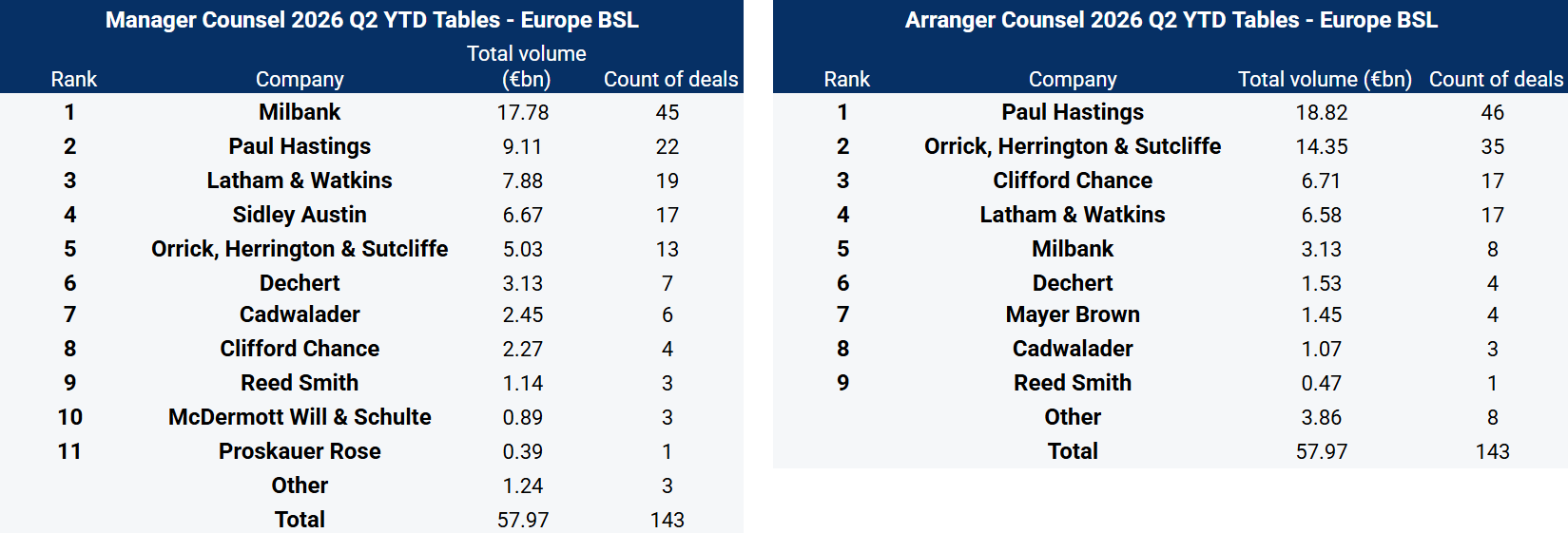
In Europe Milbank is firmly atop the manager counsel tables, with a 30.7% market share, and the rest of the top three also remain unchanged from Q1. Proskauer Rose added a deal in Q2 to bring the total of law firms working on deals to at least 11 this year. Paul Hastings, Orrick and Clifford Chance, retain their top three arranger counsel positions from Q1, although Latham & Watkins is now only €130m behind in fourth place, having worked on the same number of deals as Clifford Chance.
New arrivals
Sidley Austin, after bringing in Christopher Jackson and Luke Maiman to its US practice last year, has followed that up by bringing in Rebecca O’Brien alongside a number of other hires to its global finance practice. O’Brien joins from Clifford Chance, where she worked for over 10 years, and has experience working on rated feeder transactions and CFOs, as well as CLOs.
Lawton Camp joined Dechert in April, with expertise covering CLOs, credit funds, ABS and rated notes. Camp joins from Arnold & Porter, where he was partner for over 12 years, and has also worked as partner for Allen & Overy and Orrick.
As covered at the time, Konstantinos Vavelidis joined Proskauer, and in May Seward & Kissel added Taha Khan as head of its structured credit practice, with expertise that includes CLOs, aircraft ABS, rated notes and CFOs.
Meanwhile Orrick, which last year made a big sweep for a 40-lawyer CLO and ABL team, has bolstered its structured finance practice with a further four hires, including Victor Liang, Brittany Fox, and John Paul Igoe in the US, and Polly O’Brien in London.
End of an era
One of the longer-running regulatory sagas entered its final chapters in Q2, with the NAIC voting on 23 June to approve an overhaul of capital treatment for CLO holdings.
While the key takeaways — more lenient capital charges for IG-rated tranches and more punitive treatment for mezz — have been essentially clear for some time, this final step confirmed a number of key points.
This includes that the “thickness” (or thinness) penalty for smaller tranches would be measured on an ongoing basis instead of at-pricing. Alongside the anticipated movement of insurers up the capital stack, this is expected to reduce the amount of smaller junior triple-B tranches, sources say, as their size would make holding these tranches too costly for insurers.
The other notable update was the extension of the new framework to PC CLOs as well as BSL CLOs, although the thickness penalty will not be transferred. Applying a blanket policy has not been universally well received, with 9fin reporting last quarter that some market participants were hoping for more bespoke treatment.
Following the sign-off from the NAIC, the proposal went to the Capital Adequacy Task Force on 30 June, before a final vote by the Financial Condition Committee on 8 July.
Lawrence Hamilton, partner at Mayer Brown, confirmed in a public note that the proposals had been approved by the FCC “E” Committee, but that it declined a request from commenters to direct the working group to commission analytical work on PC CLOs by the American Academy of Actuaries, to potentially make changes in time for the 2027 RBC calculation.
The chair of the committee stated that the chair of the working group would provide details on next projects at the NAIC summer national meeting in August.
The new RBC factors will go into effect on 31 December 2026.
Selective treatment of defaults
One new trend that CLO managers and investors have begun pushing for is a change to how selective defaults are treated by CLOs.
Currently, the market-standard is that CLOs must treat selective defaults like any other default, regardless of how long the asset is due to remain in that transitional designation. This means that CLOs might be unlucky in taking a hit on an asset depending on when their reporting period falls.
The language CLO managers and some investors are pushing for would allow a grace period, typically of say 30 days, where a loan in SD under that period can be treated as not-defaulted for test calculation purposes, according to sources.
“We're increasingly going out with language that preserves flexibility around selective defaults, and rating agencies accept it because it's conceived with rating agency criteria in mind,” says Christopher Jackson, partner at Sidley Austin. “And it's really just a question of finding an investor that you're willing and able to argue with over a change like this to something they've seen a thousand times in a different form.”
Although there is some precedent in older European deals, whether this is making it through to new issue docs in the US remains to be seen.
“It's appearing in more first drafts of new docs, whether it actually gets to the document that is executed and priced is a different question,” says Jackson.
In Europe as well, grace period language has appeared in preliminary deals, according to Dealscribe, but has not yet made its way into any executed docs.
Impairments
One of the headline grabbing developments in Q2 was the first “default” of a European CLO tranche in the 2.0 era by Bain Euro CLO 2018-1, with the second, Man GLG Euro CLO III, hot on its heels (a notice published on 15 July confirmed the redemption).
We use air quotes around default advisedly, as in neither instance was there a strict default by the terms of the documentation. Essentially, in exchange for a swift redemption and some returns on their principal, class F noteholders agreed to receive less than the full amount due, which avoids a full default scenario — although rating agencies label it equivalent of a distressed exchange and “tantamount” to a default.
Opinions differ on how much of a trend this is likely to be. Not only do the MVOC levels need to be in the right middle zone where an impairment is necessary but there is still enough value left in the deal for it to be worthwhile for noteholders, but the documentation itself and the process of securing approval differs from deal to deal.
"It comes down to what the docs say. The level of approval required depends on what needs to change. There are what we call basic terms modifications (this would typically include changes to payments due on the notes),” says Martin Sharkey, partner at McDermott Will & Schulte, “to amend those, you'd typically need an extraordinary resolution, usually two-thirds of note holders, though that threshold can vary deal by deal."
"All of this is negotiated when the initial documentation is put together. Older deals tended to have more flexibility to change terms without note holder consent,” adds Sharkey. “In newer issues, note holders may have negotiated controlling class consent for specific changes — such as changes to the WAL test — and you might even need mezz consents for things like WAL test and other collateral quality test changes.”
Although negotiations are likely to be complex, 17 deals are currently out of reinvestment and have single-B tranches uncovered, according to a 26 June Deutsche Bank research report, meaning there is opportunity for reoccurrence.
Although Deutsche Bank research adds the important caveat many of these single-Bs have relatively high single-B NAVs which reduce incentives to call, and its “long-held view is that many larger platform managers will opt to redeem these deals in full – often via a reset – to protect their platform brand and avoid the negative precedent of a write-down of any part of the debt stack.”
Bringing CLO ratings up to date
A major feature of the last quarter was a pair of updates from rating agencies, which were designed to update and modernise rating criteria as it pertained to CLO tranches.
First, towards the end of April, Fitch proposed an overhaul of its rating criteria, which it announced had been finalised on 1 June.
The update included aligning recovery assumptions for private credit and broadly syndicated loans, revised recovery timing assumptions, and updates the treatment of triple-C excess haircuts.
The net effect is that 5% to 15% of CLO note ratings would likely be affected, which is anticipated to lead to upgrades of one-to-two notches.
On 5 June, Moody’s announced that it was also proposing changes to its rating methodology, which includes updating the default probability stress used to calculate expected losses, and introducing an “actual-metrics” model.
The changes were expected to potential upgrade up to a third of CLO tranches (below triple-A level) in the US and Europe, by one or two notches. The request for comment deadline has now passed on 6 July, although there has yet to be an official update following the comment period.
Whilst the changes are clearly net-positive for CLO investors (and managers), they have kept lawyers busy. They not only have to accommodate the updated Fitch criteria, but plan for the potential Moody’s changes as well.
According to James Baillie, partner at Paul Hastings, in Europe managers have been implementing these criteria adjustments for new deals, and in some cases, amending existing deals to benefit from the updated criteria. He noted that the process largely depends on the deal-specific documentation.
While some documents require either negative consent or a majority positive consent from the triple-A investor, most documents do not require any investor consent at all.
In the US, the changes whilst positive require some effort to onboard.
“We’re building a lot more hardwired flexibility into CLO docs to account for the recent update to the Fitch guidance and pending Moody’s changes as well,” says Jackson, “so it’s adding a lot of front-end work to do. Things are taking a little longer than they ought to.”


