
A relatively busy start to the year in primary issuance gave CLO lawyers plenty to do in January and February, even if market momentum cooled in March with geopolitics injecting fresh uncertainty.
The pipeline was underpinned by a strong warehousing backdrop. Warehouse formation had remained robust through the end of 2025, with around 300 open facilities in the US as of late last year, according to Maples, pointing to expectations of continued CLO issuance and sustained demand for leveraged loans.
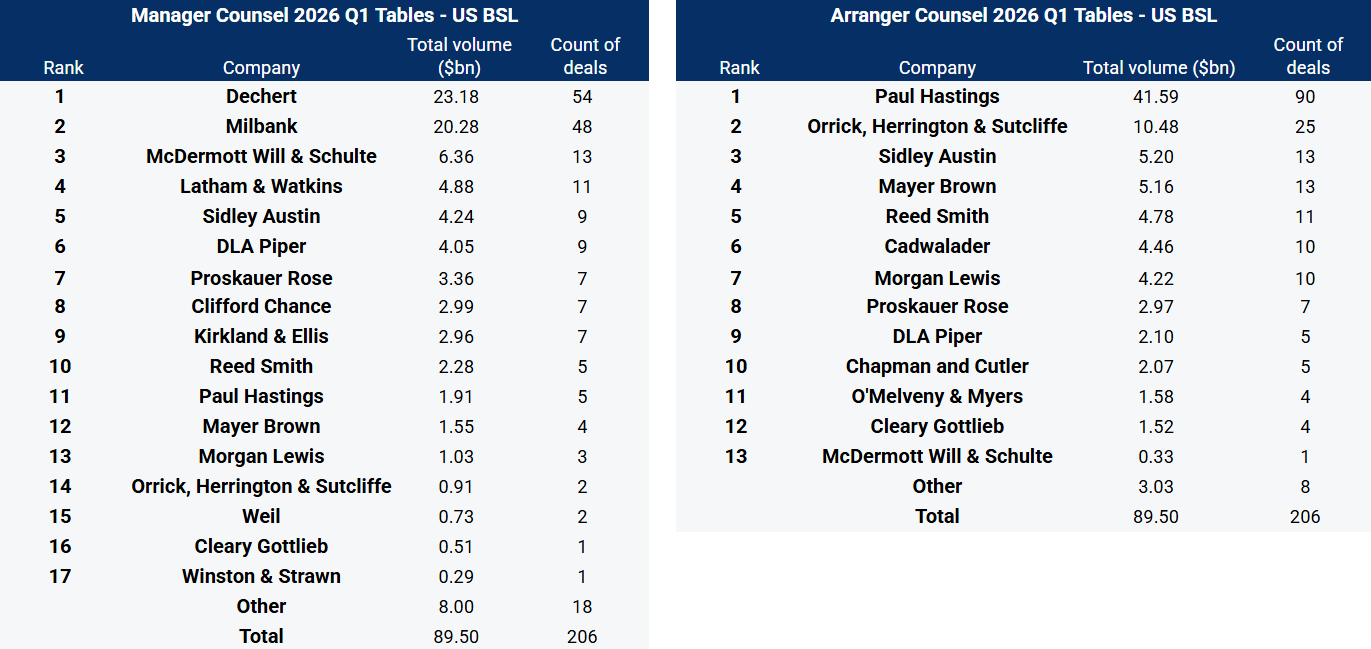
Dechert climbed to the top of the US BSL CLO manager counsel rankings for Q1 after 2025 brought it within touching distance of Milbank. With $23.18bn across 54 deals in Q1 2026, Dechert edged ahead of Milbank’s $20.28bn across 48 transactions. The newly combined McDermott, Will & Schulte also featured in the top tier, advising on $6.36bn across 13 deals, in a market that saw 206 US BSL CLO transactions in the quarter.
On the arranger side, there remains no ambiguity. After advising on 396 deals in 2025, Paul Hastings maintain its grip on the arranger counsel market. The law firm again dominated the US BSL rankings, acting on 90 of 206 deals in Q1, ahead of Orrick on 25 and Sidley Austin and Mayer Brown on 13 each.
Orrick’s second-place finish is notable in its own right. After Cadwalader ranked second in the 2025 US BSL arranger counsel tables with 101 deals, partner moves from Cadwalader to Orrick perhaps explain the firm’s strong start to 2026.
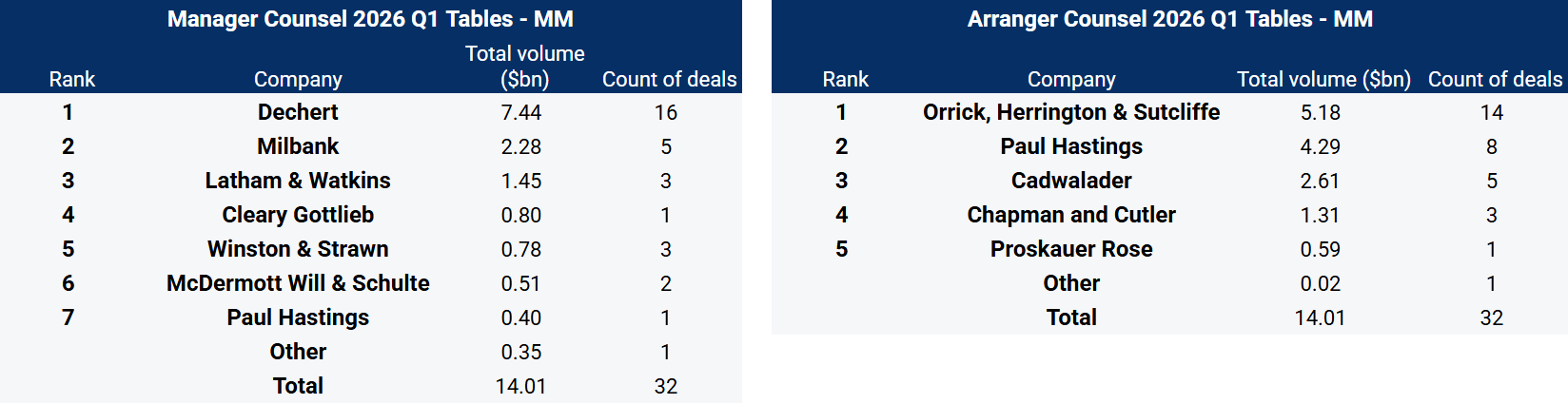
Mid-market tables produced a familiar split, with some shifting dynamics underneath.
Dechert led manager counsel rankings in Q1 2026 with 16 of 32 deals, extending a leadership position it established in 2025, when it advised on 59 of 148 middle-market transactions.
Orrick, meanwhile, topped the arranger counsel table with 14 of 32 deals. In 2025, Paul Hastings led with 42 of 148 deals, followed by Cadwalader on 38 and Chapman on 20, while Orrick was back on 10.
In Europe, the top of the tables were more stable.
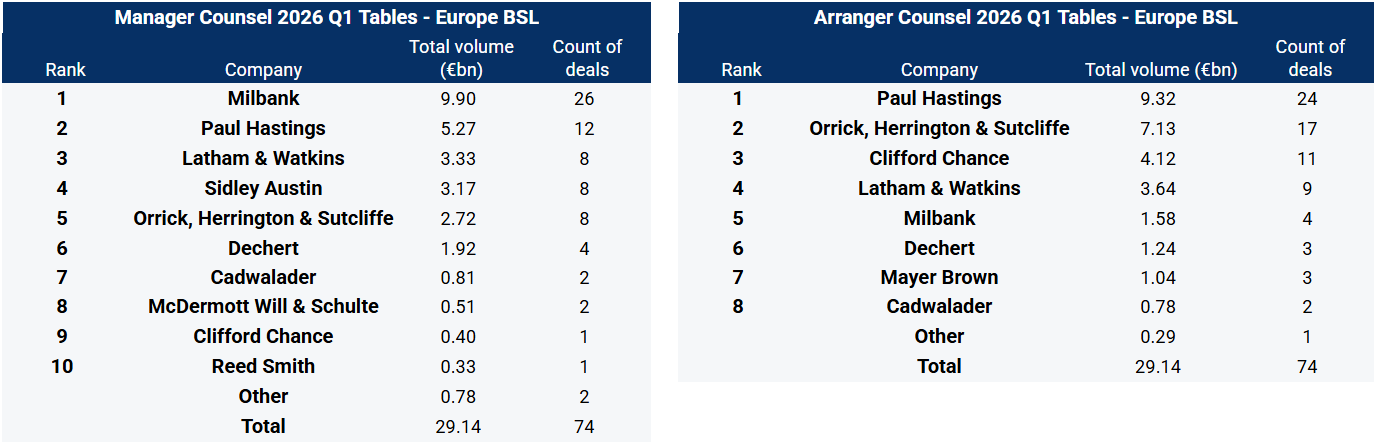
Milbank preserved its lead for BSL manager counsel mandates, advising on 26 of 74 deals in Q1 after topping the 2025 rankings with 101 of 298. Paul Hastings remained second in Q1 on 12, while Latham, Sidley and Orrick each worked on eight transactions.
As arranger counsel in Europe, Paul Hastings again set the pace, taking 24 of 74 deals in the first quarter, ahead of Orrick on 17 and Clifford Chance on 11. That follows a strong 2025 in which Paul Hastings led with 77 of 298 deals, ahead of Cadwalader on 68 and Latham on 40. Orrick’s stronger placing here shows the firm gained traction across arranger-side mandates.
And whilst people moves weren’t quite as fast-flowing as we saw at some points last year, there were a number of partner moves and promotions in Q1. In London, Alex Martin, who joined Milbank in 2024 from Latham & Watkins, has taken over the reins of the firm’s London alternative investments practice following the retirement of partner James Warbey at the end of last year. In his new role he’ll work closely with Sean Solis, the firm’s global head of the group, who is based in New York.
Cary Nadelman joined DLA Piper in the US as part of the structured finance subgroup, after previously working as first special counsel and then partner at Chapman & Cutler. Partner Konstantinos Vavelidis left the firm’s CLO practice at the end of last year.
Most recently Dechert announced yesterday that Lawton Camp had joined its New York office to strengthen the firm’s CLO capabilities (amongst other areas), moving from Arnold & Porter where he had been a partner for 12 years.
Cashless rolls
One documentary development in recent months in European CLOs has been around loan repricings effectuated by way of cashless roll, or substitutions or novations. Lawyers say rating agencies, and Fitch in particular, have pushed for documentation that makes clear managers cannot use cashless roll mechanics to sidestep a transaction’s reinvestment criteria, particularly post-reinvestment period when failing CLO tests may restrict CLO reinvestment.
Robert Wyse Jackson, partner at Milbank says: “Rating agencies are looking for documentary comfort that, in the event there is an ordinary course loan repricing, such loan repricing is treated as a new acquisition, regardless of whether such repricing is effected by way of cashless roll, or novation or substitution.”
“The concern of the rating agencies is that, absent explicit language in the documents, a manager could seek to characterise a loan repricing where loan margin is reduced as a maturity amendment or a continuation of the original transaction, rather than the acquisition of a new asset, and thereby roll into the new transaction without having to comply with the usual transaction tests”, he explains.
The emerging drafting response is to make clear that repricings effected by way of cashless roll are treated as acquisitions of new obligations except where such loan repricing constitutes a restructuring or, except where loan margin is reduced, a maturity amendment, or where the collateral quality and par value tests are passing at the time of the repricing. That approach is being incorporated into new CLO issuance, with the change being noteworthy in a market where repricings of leveraged loans are more common than fresh BSL new issuance.
Post-pricing flex
At the same time, European CLO managers are still succeeding in pushing through some additional flexibility of their own. One example is so-called reset post-pricing flexibility, which Azeem Sulemanji, partner at Sidley says is now being drafted into a number of deals.
The mechanic is intended to enable managers, following the pricing of a CLO reset, to manage their portfolios by reference to the reinvestment criteria and portfolio profile tests of the intended reset transaction, rather than waiting until the reset itself has closed.
That, he says, gives managers “a bit more flexibility post-pricing” and means they “can reinvest as if the reset has closed, to allow the manager to ramp the portfolio towards the target par of the priced deal during the price-to-close window and take advantage of potentially more flexible reinvestment criteria and portfolio profile tests negotiated for the reset.”
Although the feature only becomes operative when the transaction is eventually reset, its inclusion now is essentially a form of future-proofing in the event that the target par is increased on a future reset or the CLO experiences significant deleveraging prior to the pricing of a future reset. The mechanic however, has not gone uncontested.
The drafting has gone through “several iterations” following investor and rating agency feedback with such parties seeking to limit par erosion on the outstanding CLO notes in the event that the issuance of the refinancing notes fails post-pricing. The provision is nevertheless finding its way into deals but by limiting the post-pricing period during which the post-reset reinvestment criteria and PPTs apply to no longer than 30 days and requiring rating agency confirmations.
Another feature still carrying forward is the WAL test step-up.
Sulemanji says the WAL test step up trend continued into Q1, extending a trend that gathered pace over the last 12 months. The concept is to allow the WAL test end date to move out, typically back to the WAL test limit at the issue date of the CLO, if certain conditions are met, principally that the collateral principal amount is at least equal to the reinvestment target par balance, the collateral quality tests are satisfied and, in some cases, a rating agency confirmation is obtained. The feature gives managers some additional runway as transactions season and portfolios naturally amortise, and Sulemanji says it has continued to appear in a number of recent deals, including through Q1.
NAIC, Securitisation Regulations, Cayman reporting
In Europe, ECON is expected to negotiate the Securitisation Regulation provisions in the coming weeks, followed by the CRR provisions. A final ECON vote on the Parliament’s negotiating position is scheduled for early May 2026.
Trilogue negotiations between the European Commission, Council and Parliament are expected to commence in the second half of 2026, likely in late spring or early summer. Formal adoption and publication of the amending regulations are not expected until late 2026 or early 2027.
Rich Reilly, partner at DLA Piper, tells 9fin he sees more US CLOs being structured to comply with the EU/UK Securitisation Regulations.
“In some cases, smaller managers that haven’t yet set up an EU/UK compliant platform have been told by their arrangers that one or more deals needs to be compliant in order to expand the universe of potential investors,” he says.
“One of the issues that managers need to consider when setting up a new EU/UK compliant platform is how to satisfy the requirement under the ‘sole purpose test’ that non-retention related revenues exceed 50% of the total revenue of the total revenues of the retention holder. Some managers have had to move non-retention related assets to the retention holder entity in order to accomplish this objective.”
In the US, as reported, the long-running saga of the NAIC introducing new capital charges for CLO tranches looks to be finally heading towards a conclusion by-year end.
As detailed in the article, new charges, if approved, would mean significantly lower capital charges for single-As and above, and significantly higher capital charges for triple-B and below tranches, which will be a boost to demand for senior CLO tranches.
The NAIC is on schedule to implement the new capital charges for the start of 2027. Comments on the charges would be due by the end of this month.
Mayer Brown’s Art Rublin told 9fin — “We’ve been engaged by the Structured Finance Association to help with the preparation of a comment letter on a set of modeled risk-based capital factors recommended by the American Academy of Actuaries to a working group of the National Association of Insurance Commissioners for insurer investment in CLO notes.”
One area of focus is how private CLOs would be treated from an capital charge perspective, according to one source, with a “strong preference for change with respect to the RBC treatment of private credit CLOs to be deferred until something can be tailored to that asset class.”
There’s a good chance that the Academy model for BSL CLOs could well be in place for YE 2026, the source added, which may mean realistically the private-credit CLO RBC changes would not come into effect until earliest YE 2027.
In the Cayman Islands, effective 1 January 2026, the Cayman Islands Common Reporting Standard ("CRS") compliance regime was updated. Per a report by Maples, the “provision of a Principal Point of Contact must now be a person located in the Cayman Islands.”
“Following client enquiries regarding the recent CRS amendments, we can confirm that these amendments do not alter the existing position with respect to investors who hold their notes in global form via a nominee or custodial arrangement,” the report said. “Provided the nominee or custodian is a Financial Institution for purposes of the CRS regime (which will invariably be the case for CLO transactions), there is no requirement for the CLO Issuer to obtain CRS self- certification forms from the ultimate beneficial owners of any global notes.”
CLOs amend language around withholding tax
Following 9fin breaking the news on CFC Group and withholding tax in CLOs, sources say some CLOs have now begun amending language around withholding taxes.
The market standard has been to exclude obligations subject to withholding taxes through the eligibility criteria unless they include a gross-up provision. This is where the borrower agrees to make an additional payment to offset any interest lost if the obligation is ultimately subject to withholding tax.
However, in recent deals, this has been amended to allow a small proportion of obligations subject to withholding taxes without a gross-up provision.
According to a Dealscribe report, this can be seen in Northwestern Mutual’s 720 East CLO IX, which carves these permitted assets out of the withholding tax clause of the collateral obligation definition and includes a 3% concentration limit for collateral with withholding tax.
CRD VI
Banks active in the CLO market are now assessing whether loans originated or booked through London will need to migrate onto EU balance sheets, starting with warehouses and potentially extending to Class A loan tranches, sources say.
In practice, that means a bank that today provides a senior warehouse facility from London to an Irish SPV may, under the toughest reading of the new rules, need to shift that exposure to Dublin, Frankfurt or another EU hub.
The same question is coming into focus for CLO loan tranches: can a bank still lend from London to an Irish issuer, or does that risk now have to sit in an EU entity?
Uncertainty stems from Article 21c of CRD VI, the EU’s new cross-border directive for third-country banks. The rule is not specific to CLOs or even structured finance. It is sector-agnostic and cuts across aviation, corporate lending, real estate lending and other forms of credit activity.
"At its simplest, the provision could stop a non-EU bank from lending to an EU customer unless it has an authorised branch or licensed bank inside the bloc,” said one lawyer. The fight now is over how far that goes. One camp reads it as a straightforward customer-location test, which would put Irish warehouse vehicles and CLO issuers squarely in scope. Another argues the better view is to look at where the lending business is actually being carried out from, giving London-based banks more room to keep originating there.
The distinction matters because the regime applies to banks and credit institutions, not to non-banks, sources say. Some London-based firms are seen as better positioned simply because they are not banks.


