The bell has been rung. After speculation and questions about a possible Ardagh equity exit since its 2025 restructuring, the company announced last week that it has put its 76% stake in Ardagh Metal on the block.
Some focus had been on a possible exit of Ardagh Group equity rather than Ardagh Metal so the news may have an element of surprise. The clear implication, of course, is there would be no immediate secondary market exit for creditors-turned shareholders of Ardagh Group. That would only be provided by a sale of Ardagh Group equity. That’s not to say this won’t benefit Ardagh Group shareholders.
It’s been abundantly clear to anyone following Ardagh that the material equity value sits at Ardagh Metal. That’s the reason it was the focal point of so many offers and counter-offers from restructuring stakeholders, and the reason creditors fought so hard to wrestle control from incumbent shareholders. It is unequivocally the crown jewel.
So what is it worth? What will it mean for Ardagh Group creditors and for Ardagh Group shareholders? Will it provide decent recoveries for legacy holders, and what could it mean for the credit profile of the Ardagh Glass business going forward?
What’s it worth?
Ardagh Metal’s share price (AMBP ticker) as of writing is $5.35 for a market cap of $3.2bn. It’s up around 29% year-to-date, a little ahead of peers, but its rise since mid-June broadly aligns to peers, suggesting there hasn’t been a material idiosyncratic rise from the stake sale news.
For the sake of brevity and simplicity, we’re going to use the current share price as our proxy for the price-per-share Ardagh could achieve. In reality, there are several puts and takes. Ardagh could invoke Article 13 to squeeze out the remaining minority shareholders at fair market value, enabling it to sell 100% of AMP to a prospective buyer. A prospective buyer could also invoke this right if it bought Ardagh’s 76% stake. And of course there is no certainty a prospective buyer would pay the same price for Ardagh’s 76% stake as the 24% listed stake, though we would not expect any buyer would pay Ardagh a spread above fair market value for the listed stake if Ardagh first bought it.
The current market cap of $3.2bn implies an enterprise value of ~$7.4bn, including Q2 26 net debt of $4.2bn. This is a 9.3x multiple over LTM Q2 26 EBITDA of $793m, which is at the upper end of the ~7.8x-9.4x range the business has traded at since the start of 2024. It sits in the middle of peers Crown (8.6x) and Ball Corporation (10.7x), as of writing, according to Koyfin data. All told it seems like a fair multiple.
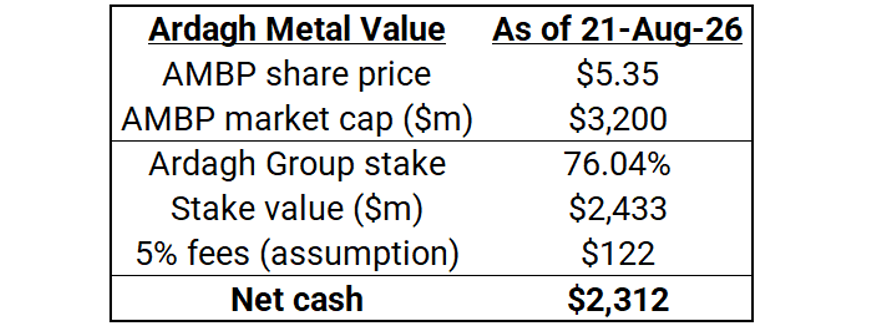
At the current share price, Ardagh’s 76% stake is worth ~$2.4bn. After 5% fees we assume that would provide around $2.3bn net cash to Ardagh. Then there is the question of what to do with the cash.
The 1L, 2L dilemma
There’s useful recent precedent for what Ardagh could do with the AMP cash. After its preference shares in AMP were redeemed in late 2025, $200m cash was retained for capex, with the excess ~$90m used to make a mandatory repurchase offer for both the 1L and 2L notes in late June.
The company offered to tender the 1L notes at 101.5, close to five points below where they were indicated at the time, but perfectly in line with the excess proceeds provision in the bond docs. Tendering 1L noteholders would be given priority acceptance ahead of tendering 2L bondholders, who were being offered a par repurchase, again in line with the excess proceeds provision.
Unsurprisingly, only $55.5m nominal value of the 1L notes were tendered and repurchased (at 101.5). This left ~$28m cash to pro rata repurchase the 2L notes, which were both very largely tendered at €1.087bn on the euros and $1.18bn on the dollars. The motivation for 2L noteholders was clear - they were set to earn close to seven points of upside from their ~92.7-mid cash price as of 22 June, the date the offer was launched.
There might be scenarios in which the excess proceeds provision is amended or removed by bondholders in the event AMP is sold, but for the sake of this analysis we’ll assume the same rules apply again.
That means proceeds must be offered on a priority basis to 1L noteholders at 101.5. The bonds are indicated at 104.8-mid as of writing, down around two points since the AMP news on the prospect of again being offered to tender at 101.5. Presumably some of this drop will have been on the back of bondholders trying at the higher market price.
The three point gap between market price and tender price is something bondholders will have to weigh if and when AMP is sold. The 1L notes are NC3, but there is very little prospect of holding out to be called following a sale of AMP as 2L noteholders would likely tender en masse again, consuming all remaining cash not used to repurchase 1L notes at 101.5.
We saw this play out in the excess proceeds offer in June/July, with 85% nominal principal of the euro 2L notes tendering, and 94% of the dollar 2L notes tendering. There is every reason to believe the same would happen again, as the notes are still indicated at 96-mid as of writing, offering just shy of four points of upside from the current mid price if they’re repurchased at par.
This is the bind for 1L noteholders. There’s probably limited liquidity in the bonds now with the prospect of 101.5 repurchases on the table. And opting to crystallise a handful of cash price points loss tendering at 101.5 is a bitter pill. But the impetus is there as cash would otherwise be used to repurchase the 2L notes. And of course there’s the tail risk of continuing to hold the 1L through a sale of AMP and hoping the notes continue to trade well above par after cash proceeds are used to mop up willing 1L and 2L noteholders.
This is where the post-transaction cap structure and business profile comes in.
The right leverage profile eventually found
Assuming net proceeds from the 76% AMP sale are ~$2.3bn and the 1L notes are taken out in priority ahead of the 2L notes, pro forma Ardagh Glass net leverage comes in at around 3.7x based on LTM Q2 26 earnings. Post-transaction and pre-transaction leverage figures are not like-for-like as Ardagh’s own 5.5x Q2 26 leverage figure for the glass business (ARGID) includes $183m of AMP common dividends, which of course fall away post-sale.
You’ll see in the table below that Ardagh Glass was 7.1x levered on Glass EBITDA without AMP dividends as of Q2 26. Like we said, there is no clean comparison between pre and post-transaction leverage. That said, 3.7x leverage post-transaction is a comfortable level for Ardagh Glass, especially when it’s likely to be able to refinance the cap stack at a cheaper cost of finance.
Larger image here
Here’s how the use of cash proceeds breaks down if the 1L is entirely redeemed ahead of 2L redemptions. The use of cash and how leverage shakes out doesn’t change materially if less of the 1L is tendered and repurchased, with more money heading to the 2L instead.
So what does this mean for recoveries for shareholders?
Recoveries boosted thanks to AMP surge
We’ll break this down into a handful of categories.
We said from the outset that the new money looked expensive and that it may present a quick profitable exit for providers. That played out, with initial providers offered anything from a six-to-eight point exit premium in the secondary market once the new notes broke to trade. Let’s call that 100%+ recovery. And if you tender now at 101.5%, that’s your recovery level. Hold out for redemption further out (i.e. after cash from AMP sale is used) and you’re probably thinking par-plus recovery.
The legacy Ardagh Glass SSNs that became the 2L notes as part of the transaction would likely be partially repurchased with proceeds from the AMP sale. That would represent a 100% or par recovery. Where they won’t all be repurchased as there isn’t enough cash, full 100% or par recovery isn’t a certainty but the pro forma leverage profile and capital structure looks more refinanceable and it increases the likelihood of a par outcome for legacy Ardagh Glass SSN holders who became 2L bondholders as part of the restructuring.
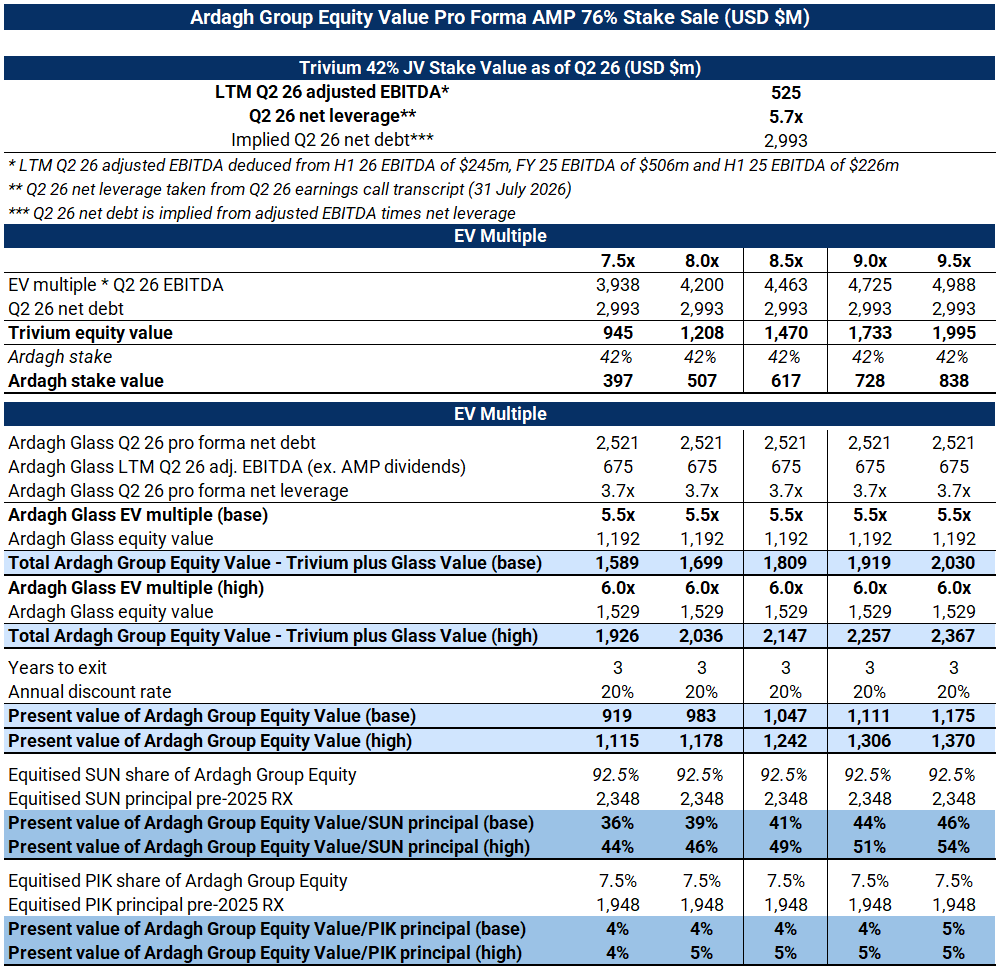
Then there’s the legacy Ardagh Glass SUNs. They were equitised for 92.5% equity in Ardagh Group. We said when the restructuring closed the $2.4bn of nominal SUN principal looked 40%-68% covered by day-one equity value across the entire Ardagh Group complex (i.e. AMP, Ardagh Glass and Trivium). That didn’t take into account a discount on future equity value, which when applied dropped prospective recoveries to 23%-40%.
We looked at prospective recoveries again during Q1 26 earnings in April. They had increased to 30%-48% for legacy SUN holders by this time, courtesy of better Trivium value and moderately better AMP value.
Prospective recoveries have increased further yet as of writing, thanks to the appreciation in AMP’s share price since June. As you’ll see in the table below, accounting for a three-year exit window on equity and a 20% annual equity return, prospective recoveries for legacy SUN holders now are 36%-54%.
Larger image here
The SUNs were indicated at a cash price of ~29 before the restructuring was executed, but they were largely locked up from late July/early August 2025 when the TSA was first announced. At that point in time they were indicated at ~47-mid, meaning prospective recoveries right now look a little more skewed towards potential loss than 100% recovery relative to early August 2025 SUN pricing levels. This is variable on exit window assumptions and annual equity return requirements, however, so is indicative and illustrative at best.
To round out recovery prospects, the legacy Ardagh PIKs are looking at a 4%-5% prospective recovery, as you’ll see in the last line of the table just above.