Anthropic dropped its highly anticipated S-1 filing on Monday (26 October), offering prospective equity investors (and anxious debt investors) a look at the frontier AI lab’s finances as it prepares for a potentially record-breaking IPO.
The filing comes as investors grow more wary of the AI build-out. And while Anthropic is putting its massive revenue generation on display with an impressive turn to positive cash flow, the company is also piling on compute commitments that it warns will lead to significantly higher capex in the years to come.
Revenue reached $16.3bn in the first half of 2026, up from $1.2bn in the first half of 2025 and already exceeding full-year 2025 revenue of $4.6bn. The company generated $3.9bn in operating cash flow, even as it reported an $80.7bn net loss driven largely by a non-cash charge from the rising value of its convertible notes.
Although Anthropic has used off-balance-sheet structures to finance GPUs, this rapid revenue growth has so far come without the heavy capex and bond issuance that weigh on the other hyperscalers. The company only spent $482m on capex in H1 26, renting most of its compute from cloud providers instead. Its largest expense category was compute and infrastructure, at $8.9bn.
But the S-1 paints a picture of a company that will have to keep growing rapidly to meet its mounting compute obligations.
Revenue growth
Anthropic’s revenue grew from $41m in 2023 to $4.6bn in 2025, then reached $16.3bn in the first half of 2026. Consumption-based revenue, primarily from businesses accessing Claude through its API and cloud platforms, accounted for 80% of the total; subscriptions made up the remaining 20%.
Growth has been driven by large business customers. The number of businesses spending more than $100,000 over the past twelve months rose from around 1,500 at the end of 2025 to more than 11,900 by September. Customers in that bracket generated 76% of revenue last year. No single customer accounted for more than 10% of revenue in the nine months to September, while the top five accounted for about 25%.
Source: Anthropic, PBC - S-1, 9fin analysis
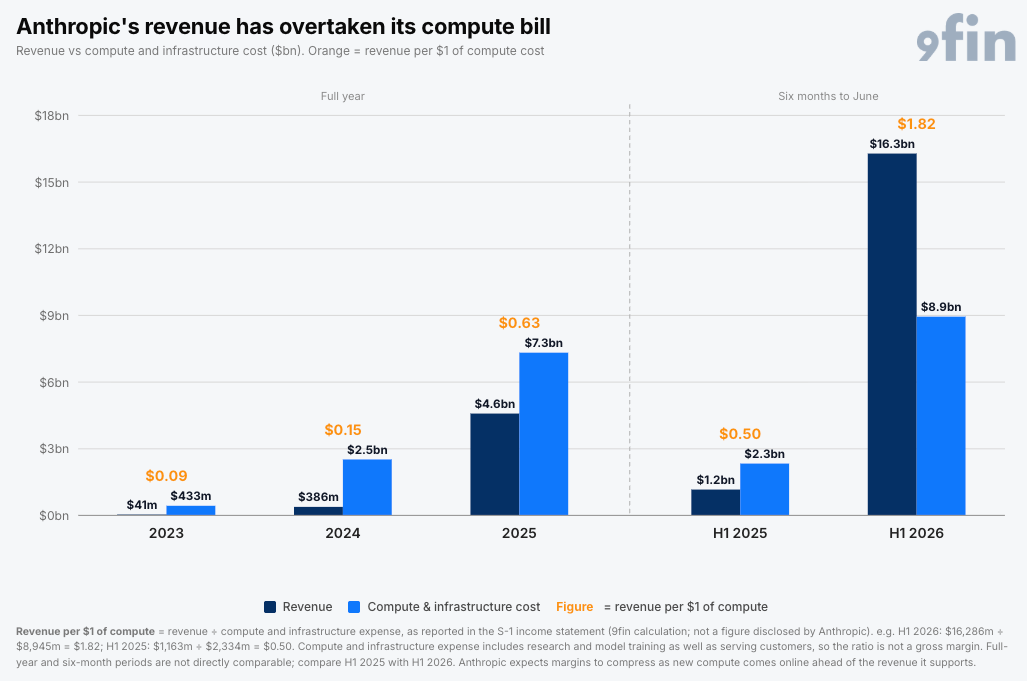
Revenue has outpaced the cost of the compute behind it. Anthropic generated $1.82 in revenue for every dollar spent on compute and infrastructure in the first half of 2026, up from $0.50 a year earlier. The company said revenue grew 1,368% year-over-year in the second quarter, compared with 300% growth in compute costs.
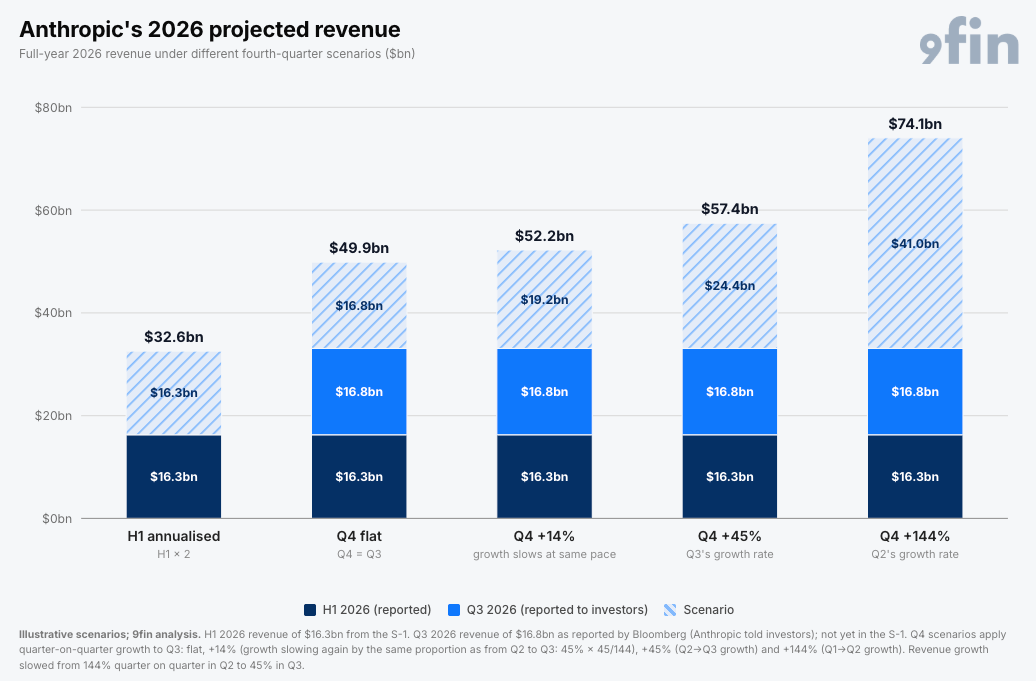
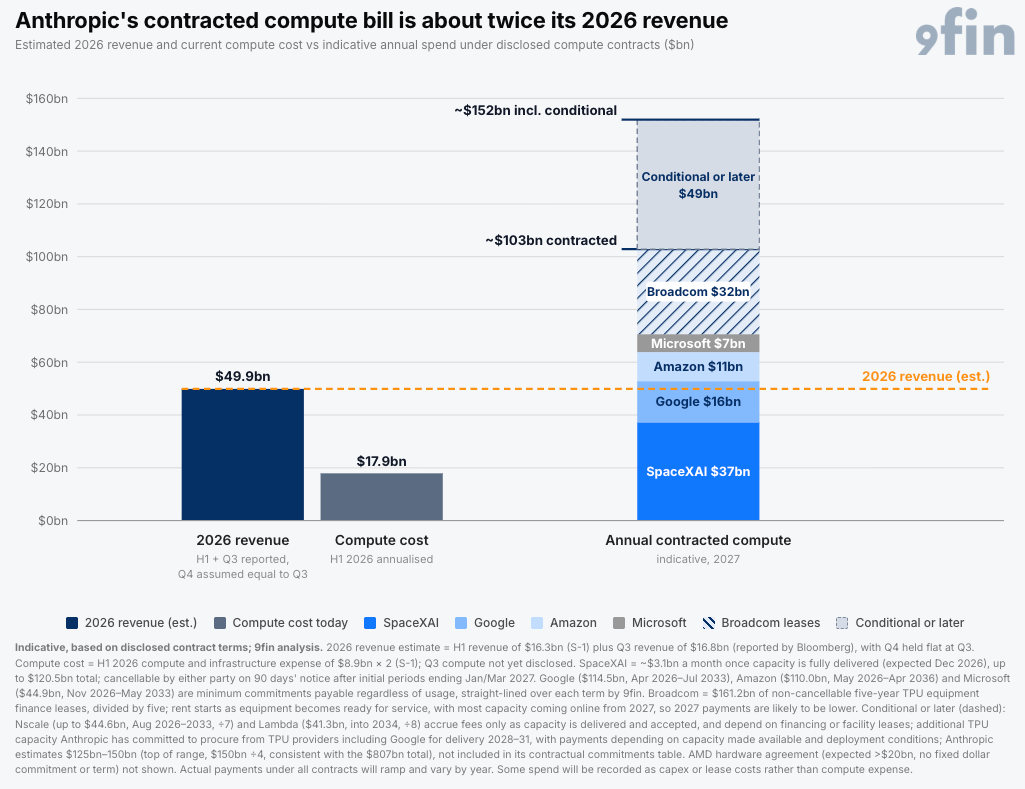
Anthropic’s first-half revenue implies annualized revenue of roughly $33bn, but reports suggest that Anthropic has already exceeded H1 26 revenue in the third quarter alone. That puts the company on pace to generate around $50bn in revenue this year.
Source: Anthropic, PBC - S-1, Bloomberg, 9fin analysis
But the filing cautions that its growth rate is expected to decline over time (a growth rate of more than 1,000% would be hard to maintain). The question is whether revenue can keep growing fast enough to absorb the infrastructure costs Anthropic has already committed to.
Locked-in compute costs
Anthropic has committed to spend as much as $807bn on chips, data centers and cloud computing capacity in the coming years, and at least $430bn of that is locked in and can’t be exited.
Its firmest commitments are with cloud providers: $114.5bn to Google through July 2033, $110bn to Amazon through April 2036 and $44.9bn to Microsoft through May 2033, “regardless of actual usage”. It has also committed to $161.2bn in five-year equipment leases with Broadcom, excluding interest. Neither party can cancel the leases, and most of the capacity is due to come online from 2027. The leases are secured on the equipment and guaranteed by Anthropic.
Anthropic has also agreed to spend up to $120.5bn with SpaceX’s AI subsidiary, about $3.1bn a month once the capacity is fully delivered. In contrast to the other agreements, either party can cancel this one on 90 days’ notice after the initial periods end in early 2027.
The contracts do not require equal annual payments, and spending will rise as capacity is delivered. But if spread evenly over their terms, the commitments would cost Anthropic roughly $103bn a year, compared with annualized compute costs of $17.9bn and estimated 2026 revenue of around $50bn. The non-cancellable deals alone would average about $66bn a year, roughly a third more than its estimated 2026 revenue.
Other commitments are not included in those figures. Agreements with Nscale and Lambda depend on capacity being delivered and, in some cases, financed. Anthropic has also committed to buy additional TPU capacity from providers including Google for delivery between 2028 and 2031. It estimates this will cost $125bn–$150bn, though payments depend on how much capacity is delivered and deployed. It also expects to spend more than $20bn on AMD hardware under a July agreement it cannot cancel, while AMD has committed to buy up to $5bn of Anthropic stock as its chips are delivered. Including the Nscale, Lambda and TPU commitments, annual spending would reach about $152bn, roughly three times its projected 2026 revenue.
Source: Anthropic, PBC - S-1, Bloomberg, 9fin analysis
It’s worth noting that this initial S-1 document has a blank chart for its contracted obligations that investors will expect to be filled out by the time the final document is procured, and until then, these obligations remain a credit question for prospective investors.
Anthropic’s case, set out in the S-1, is that revenue will grow into that capacity. It typically contracts compute 12 to 18 months before it becomes available. At the end of June, it had signed $321.4bn of compute and infrastructure leases that had yet to begin, up from $50.2bn six months earlier, and they are due to start between 2026 and 2028. So costs arrive “in advance of the full revenue that the compute will ultimately support.” As a result, it expects margins to compress as new capacity comes online.
To close the gap, Anthropic is relying on improved compute efficiency: getting more from each dollar spent. It points to three sources:
- Training: algorithmic gains it calls “compute multipliers.” Claude increasingly runs experiments, generates training data, and writes code for the next model. Anthropic calls this process “closing the loop” and said it is accelerating those gains.
- Inference: reducing the compute required to deliver a given level of model performance.
- Chips: running Claude across four chip families (Amazon’s Trainium, Google’s TPUs, Nvidia and AMD) as a single pool of capacity, shifting work to whichever hardware is cheapest and most available at any moment, which Anthropic says keeps more of its compute in productive use.
Anthropic says these gains let it cut prices, pointing to a roughly 40% reduction in customers’ cost per task with Claude Opus 5.5 compared with Opus 5. It argues that lower prices drive more usage, spreading the fixed compute bill across more revenue.
However, agentic products, which carry out multi-step tasks on their own, are “structurally more compute-intensive.” If Anthropic cannot price them high enough to cover costs, it warns, “our compute efficiency could deteriorate as agentic usage grows.”
Anthropic also warns that it may commit to more compute capacity than demand can support, leaving it without enough revenue to justify the investment.
Cash positive, for now
Anthropic recorded an $80.7bn net loss for the first half of the year, but that came mainly from a $72.4bn non-cash charge from revaluing convertible notes as its valuation rose, rather than from operating losses.
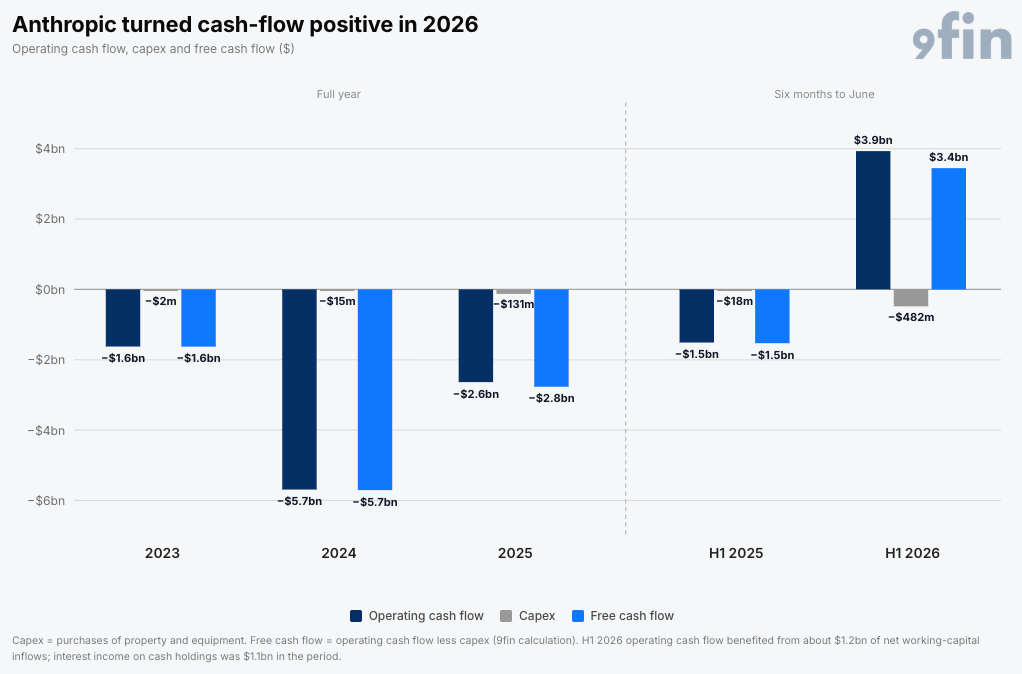
In cash terms, the business turned positive. Operating cash flow reached $3.9bn in the first half of 2026, compared with an outflow of $1.5bn in the first six months of 2025 and outflows of $2.6bn in full-year 2025 and $5.7bn in full-year 2024.
The turnaround came mainly from the business itself. Excluding non-cash charges, operations generated about $2.8bn, while the operating loss narrowed to $693m from $2.1bn a year earlier. Working capital contributed about $1.2bn as higher payables, customer prepayments and the use of previously prepaid hosting more than offset a $5bn increase in amounts owed by customers. Anthropic also earned $1.1bn of interest on its growing cash pile.
Source: Anthropic, PBC - S-1, 9fin analysis
Capex was just $482m in the first half of the year, leaving free cash flow of about $3.4bn. Capex remains low because Anthropic has mostly rented compute from cloud providers, paying as it uses it; those costs are booked as operating expenses rather than capex.
That is changing. Anthropic is moving towards chips it leases directly and houses in dedicated data centers. It expects “an increasing portion” of its compute investment to come through capex and leases “that require significant upfront payments well in advance of the related compute becoming operational,” and expects “significant net cash used in operating and investing activities for the foreseeable future.”
The mismatch is built in: most of Anthropic’s revenue depends on customers’ use of Claude and is not tied to long-term contracts. Many of its biggest customers can cut back or stop spending at any time, while its compute bills are locked in for years. At the end of June, Anthropic had just $10.8bn in contracted future revenue, compared with hundreds of billions in compute commitments. The company warns it “may enter into these obligations based on revenue expectations that may not be realized.”
At its current revenue level, positive cash flow would not last. Contracted compute of about $103bn a year compares with estimated 2026 revenue of $49.9bn. Revenue would need to reach roughly $119bn, about 2.4 times this year’s likely total, for Anthropic to break even, based on 9fin estimates.
Anthropic has a large cushion. It ended June with $131.7bn of cash and short-term investments and $3.2bn undrawn on its credit facility, after raising $110.8bn in the first half, mostly through preferred stock. That means it has burned through less than 7% of the capital it has raised.
IPO proceeds will add to that buffer, and the company is widely expected to tap debt capital markets for new bond funding once its IPO is completed (if it can obtain IG ratings). But the size of the gap means Anthropic’s ability to meet its commitments depends on revenue more than doubling from here.
For more, read 9fin’s report on Anthropic litigation risk