Markets have taken Keir Starmer’s resignation in their stride. Gilts have not blown out, sterling has remained broadly stable, and the reaction has been a far cry from the volatility triggered by the Truss mini-budget. In fact, part of the move has looked more like relief: months of leadership speculation have finally produced a clearer succession path.
For distressed debt investors, the UK’s latest political reset is more about who will occupy No. 11. With Andy Burnham’s succession appearing all but certain, attention has shifted to the chancellor appointment. For leveraged, domestic-facing credits, that choice could prove more consequential than the change in prime minister itself. Once the new prime minister is in place, the key question for credit markets will not simply be whether the government is market-friendly, but how its policies affect refinancing conditions, corporate cash generation and, ultimately, restructuring outcomes.
If Burnham opts for continuity — whether Rachel Reeves stays, or someone close to the existing fiscal framework gets the job — markets would probably view that as the lowest-volatility outcome. It would reassure gilt and credit investors that fiscal discipline remains intact, supporting refinancing conditions for rate-sensitive borrowers and sponsor-backed companies waiting for debt markets to reopen.
The drawback is that continuity does little to solve the pressures already weighing on British corporates. While UK insolvency figures have eased from recent highs, financial distress remains widespread. The businesses under the greatest pressure are not only those making political headlines but also smaller companies grappling with subdued demand, persistent wage inflation, elevated energy costs and debt refinanced at materially higher interest rates.
The picture changes if Burnham opts for a more interventionist chancellor. The frontrunner is Ed Miliband, whose appointment would likely be interpreted as signalling a more activist and greener industrial strategy.
Markets would naturally focus first on the fiscal arithmetic. More borrowing, a looser interpretation of fiscal rules or greater state intervention could push gilt yields higher, widen sterling credit spreads, and increase refinancing costs for leveraged borrowers. Companies that have survived largely because lenders have preferred to amend and extend facilities rather than crystallise losses could find themselves under renewed pressure.
But that is only one side of the story. Intervention also creates beneficiaries. Investors should be asking not simply whether borrowing costs rise, but whether government policy improves operating fundamentals. If a new administration succeeds in lowering household energy bills, accelerating infrastructure investment and increasing support for strategic industries, some sectors could emerge from this period in better shape than markets currently expect.
Construction could become the first real test case. It remains ground zero for UK distress after years of margin compression, working capital pressure and expensive debt. Companies including SIG and Huws Gray have come under pressure, and market participants expect more names to follow if trading conditions fail to improve.
A more interventionist government could create a divide within the sector. Businesses reliant on private residential and commercial development may continue to struggle if financing costs remain elevated, while contractors with significant public-sector exposure, social housing suppliers, transport operators and infrastructure businesses could benefit from higher public investment and stronger order books.
Meanwhile, a more ambitious net zero agenda could also reshape the outlook across several sectors. Companies in carbon-intensive industries such as oil and gas, traditional power generation, chemicals and heavy manufacturing could face higher compliance costs, greater investment requirements and tighter regulatory scrutiny. For highly leveraged businesses already operating on thin margins, that could add another layer of pressure.
By contrast, companies exposed to renewable energy, electricity grids, building retrofits, public transport and energy-efficiency projects could benefit from stronger policy support and increased public and private investment. Many of these businesses have seen project pipelines slow as higher interest rates squeezed financing over the past two years. A renewed push behind the energy transition could improve revenues, cash generation and ultimately credit quality across parts of those supply chains.
Consumers could also see a mixed impact. A chancellor willing to redistribute income more aggressively through higher taxes and targeted support could strengthen spending among lower-income households, providing a boost to budget retailers, pubs, leisure operators and hospitality businesses. At the same time, businesses reliant on discretionary spending from wealthier consumers could face a more challenging backdrop, depending on how those measures are funded.
Regulated infrastructure presents an even more nuanced picture. Thames Water, which remains on the brink of a special administration regime unless a long-term restructuring can be agreed, is likely to become the first major test of how the new government handles distressed strategic assets. Burnham has previously argued that water and energy should be brought back under public control, and the appointment of a chancellor with a similar interventionist outlook could reinforce that stance.
Such an approach could increase uncertainty for some creditor groups, but it could also help preserve enterprise value and operational continuity, potentially improving outcomes for senior lenders if government support stabilises the business.
The UK’s next distressed cycle may therefore be defined less by how much distress emerges than by where it migrates. Starmer’s resignation is unlikely to change that on its own. The chancellor appointment, however, could redraw the map of winners and losers across UK credit.
Let’s now take a closer look at…
This week’s news
Acacium Group (ICS) — The UK healthcare recruiter has announced the restructuring of its term loan B debt in a transaction that will hand majority control of the company to its lenders in a debt-for-equity swap. The deal, already agreed with lenders holding more than 75% of the TLB, proposes swapping roughly 60% of outstanding term loans — including accrued and unpaid interest — into equity, while replacing the existing £375m and $140m TLBs that were due to mature in 2028 with a new £200m facility that matures in 2032.
Arxada (Lonza Specialty Ingredients) — The Swiss chemicals producer has come to an agreement with over 75% of its unsecured noteholders on its restructuring plan, according to a company statement. The company said it agreed in principle to a limited number of updates to the transaction support agreement. The amendments are due to be completed this week.
Emeria (Foncia) — The French property management company’s revolving credit facility lenders are taking pitches from financial advisors this week as they gear up for restructuring negotiations with the company and its sponsor, Partners Group, according to 9fin sources. The RCF lenders are running pitch meetings over two days this week with at least eight financial advisors in the mix.
GoldenPeaks Poland — The green power producer is seeking emergency approval of bid procedures for a fast-tracked sale of substantially all of its assets, with Brookfield lined up as stalking horse bidder through a credit bid of the debtors’ outstanding DIP obligations. Unsecured creditors’ committee has appointed Womble Bond Dickinson as legal advisor in its Chapter 11 case, according to a notice of appearance filed on 18 June while pre-petition lenders may be gearing up for a fight.
Grupo Antolin — The Spanish automotive supplier launched a recapitalisation support agreement with the help of its banks to restructure approximately €1.3bn of debt — offering bondholders a choice to either extend at par to 2035 or take a discount for a nearer maturity. HSBC has acceded to the company’s recapitalisation support agreement within 24 hours of its launch, according to 9fin sources.
Huws Gray — Triple-C-rated building materials merchant reported further deterioration in its earnings for Q1 26, according to 9fin sources. The Blackstone-sponsored company reported LTM March 2026 adjusted (including synergies) EBITDA of £78m, meaning leverage has ticked up into the double digits. It now stands at 10.9x net, versus 9.9x at year-end.
Kem One — After 18 months of mounting losses, emergency rescue financings and growing creditor concerns, has finally reached a long-anticipated resolution. Sponsor Apollo is handing over the keys of French PVC maker to creditors Monarch and Arini. This is part of a comprehensive debt restructuring that will slash group debt by nearly 80%. See our analysis here.
Lipton Teas and Infusions — Lenders to the Dutch tea maker have signed a co-op agreement to organise ahead of potential talks with the sponsor CVC, according to 9fin sources. Over 50% of the first lien lenders have joined the co-op and a steering committee made up of a mix of CLOs and secondary funds has formed, the sources said. Gibson Dunn is advising the co-op group.
Selecta — All but one of the defendants in the Selecta co-op antitrust suit have filed replies to plaintiffs’ opposition briefs, pushing the initial briefing phase toward its end. The subject of the suit is a disputed multi-step LME transaction that excluded Selecta’s first-lien minority lenders, leaving them with subordinated notes indicated at comparatively lower levels than the priming notes held by a group of majority lenders.
Stark Group — The Danish building materials company’s cash fell by half year-over-year, the company reported today in its Q3 26 earnings, according to 9fin sources. The Swedish building materials company has been holding meetings with lenders to reassure them of its financial position, sources added. CVC-owned Stark has been working with Bank of America on the non-deal roadshow with its RCF and TLB lenders, sources said. It had previously hired Freshfields as legal advisor to explore options around its debt and capital structure, as 9fin reported.
TGJones — The retail chain has revised the terms of its restructuring plan after pushback from landlords, particularly dissenting creditor British Land, which still opposes the restructuring plan after the changes, according to statements from both sides. A TGJones spokesperson said that the company had improved the terms of the plan to reflect feedback received following constructive engagement with landlords.
Waldorf Production — The Court of Appeal refused HMRC permission to appeal the High Court's decision to sanction Waldorf Production UK plc’s second restructuring plan (RP2), according to 9fin sources. This marks the end of the road for the tax authority's efforts to block the company's $205m sale to Harbour Energy.
Headlines
26 June — Kem One restructures cap stack with Monarch and Arini taking the keys — Analysis (9fin)
26 June — First Brands seeks release of $25.7m factoring reserve (9fin)
25 June — First Brands secures necessary retiree committee appointment (9fin)
25 June — HSBC accedes to Antolin deal (9fin)
24 June — Selecta antitrust defendants respond as initial briefing inches to a close (9fin)
24 June — Acacium creditors to take over in debt-for-equity swap (9fin)
24 June — Stark meets lenders amid Q3 26 results showing halved cash (9fin)
24 June — Restructuring the Watchlist — Legal Analysis of European Distressed Tracker June 2026 (9fin)
24 June — Antolin signs bank agreement, aims to push deal via Spanish court (9fin)
23 June — Arxada reaches agreement with over 75% of SUNs (9fin)
23 June — Making a case for the defence — how Starmer’s resignation could impact UK credits (9fin)
22 June — First Brands court gives parties 24 hours to agree on injunction order (9fin)
22 June — GoldenPeaks creditors’ committee lawyers up as lender fight looms (9fin)
22 June — Emeria RCF lenders to receive financial advisors’ pitches (9fin)
22 June — TGJones improved restructuring terms after landlord pushback (9fin)
19 June — Court of Appeal denies HMRC permission to appeal Waldorf (9fin)
19 June — Huws Gray leverages into double digits in Q1 26 (9fin)
19 June — Lipton Teas lenders join co-op (9fin)
19 June — European Weekly Stressed and Distressed Data Report (9fin)
Lateral moves
Weil, Gotshal & Manges has appointed James Crooks as a partner in its finance practice. Crooks, who joins from Sidley Austin, specialises in advising credit funds on leveraged financings, special situations, and distressed transactions.
If you have any recent moves to announce, please send them to distressed-restructuring@9fin.com.
Weekly Declines
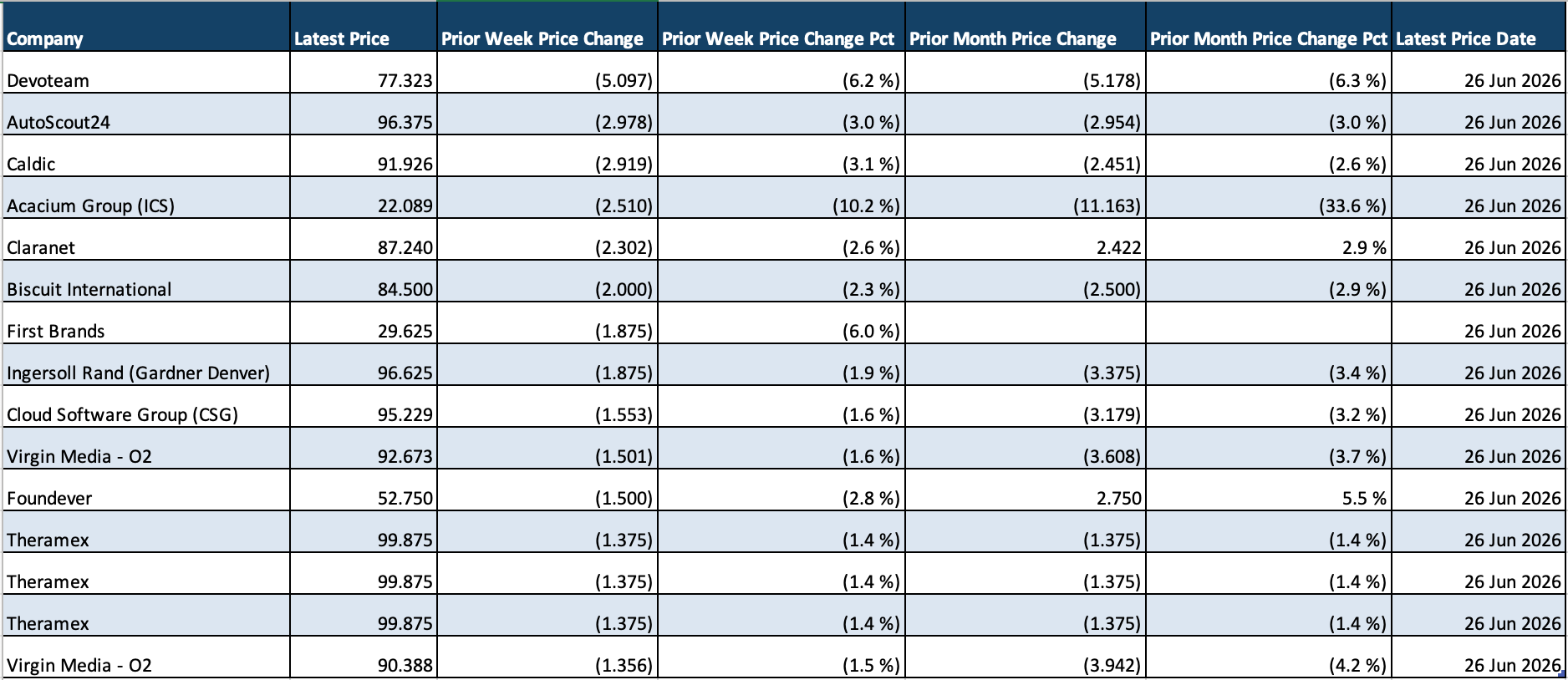
Top bond movers (full database in 9fin)
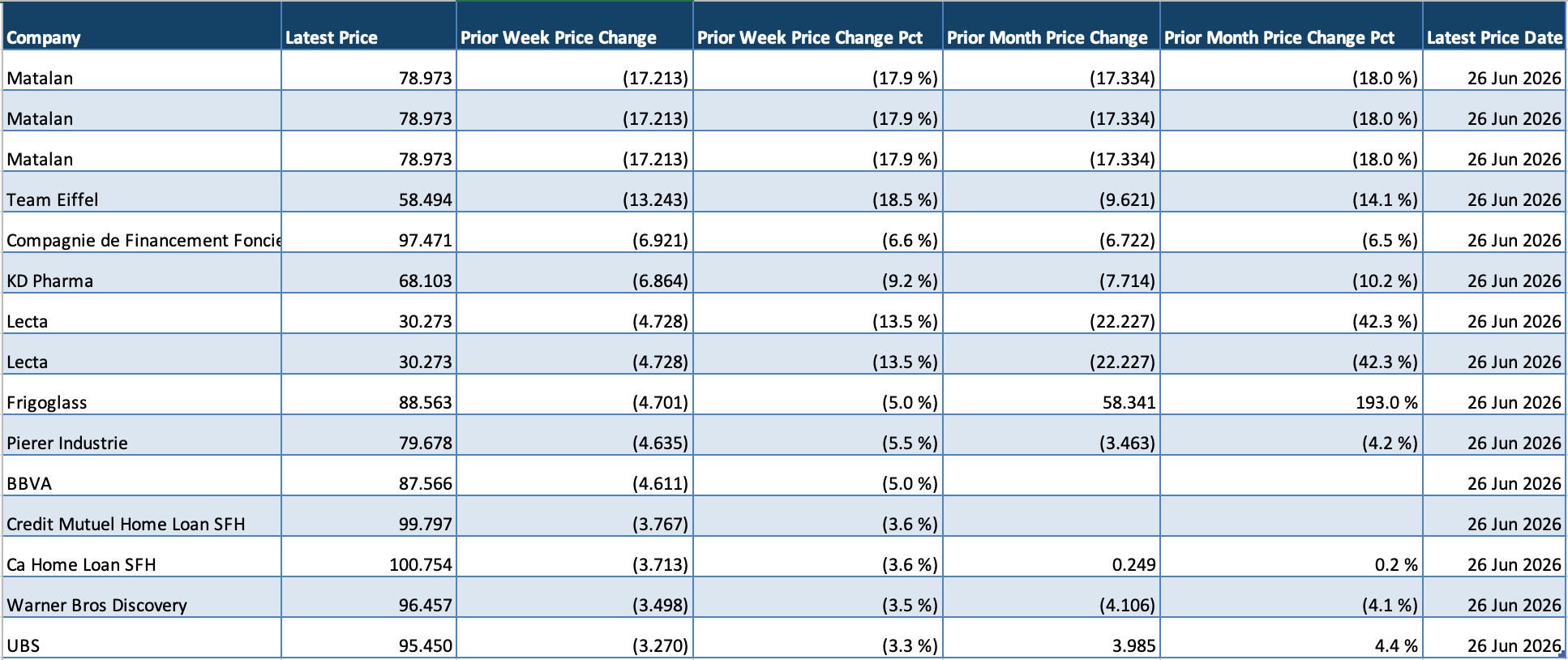
Top loan movers (full database in 9fin)