Collateralized loan obligations (CLOs) sit at the intersection of leveraged finance and structured credit. But what is a CLO? The short answer is that it is a securitized vehicle backed primarily by leveraged corporate loans and financed through debt and equity.
That definition is only the starting point. Understanding the market requires looking at both sides of that structure: the loans held by the CLO and the securities issued against them.
This guide covers the collateral pool, capital structure, cash flow waterfall, participants, structural protections, risks and information professionals monitor over the life of a CLO.
Key takeaways
What is a CLO?
A CLO is a structured credit vehicle that transforms a portfolio of corporate loans into securities with different levels of payment priority and risk.
The transaction is typically established through a special purpose vehicle (SPV), which acquires and holds the underlying loan portfolio. Those assets primarily consist of leveraged loans made to below-investment-grade corporate borrowers. These borrowers must meet the eligibility criteria, concentration limits, and other requirements set out in the CLO documentation.
The SPV finances the portfolio by issuing multiple classes of debt alongside an equity tranche. Rather than sitting on the CLO manager’s balance sheet, the assets and liabilities remain within the transaction structure, where cash is distributed according to its governing documents.
Because the collateral is tied to the broader leveraged finance market, developments affecting individual borrowers, industries, or loan terms can influence CLO performance.
A CLO is also a type of collateralized debt obligation, or CDO, but the terms are not interchangeable. CDO is the broader category of securitized debt structures. CLOs are distinguished primarily by their exposure to corporate leveraged loans, while other CDO structures may be backed by different types of debt assets.
How does a CLO work?
Exact timelines and transaction mechanics vary, but the lifecycle generally follows this sequence:
- Warehouse formation: The CLO manager begins accumulating leveraged loans through a warehouse facility before the transaction closes.
- Portfolio ramp: The manager builds the collateral pool toward the size and characteristics required for the planned CLO, subject to eligibility and concentration requirements.
- CLO closing: The CLO issues debt tranches and equity. The proceeds are used to finance the collateral portfolio and establish the transaction.
- Reinvestment period: The manager can generally buy, sell, and replace eligible collateral within the limits set by the governing documents. This allows the portfolio to respond to repayments, credit changes, and market opportunities.
- Amortization: After the reinvestment period ends, principal proceeds are increasingly directed toward paying down CLO liabilities rather than purchasing replacement collateral.
- Repayment: As the remaining loans are repaid or sold, proceeds are used to retire the outstanding securities according to the transaction’s payment priority until the CLO winds down.
Across these stages, the CLO manager’s role shifts from building and actively managing the portfolio toward preserving value and supporting the orderly repayment of the structure.
How is a CLO structured?
A CLO divides its capital structure into layers with different payment priorities and levels of protection. Senior securities are paid before subordinated securities, while equity receives residual cash after the transaction’s higher-priority obligations are met.
The image below from the 9fin platform shows how those layers compare across payment priority, structural protection, and exposure to deterioration.
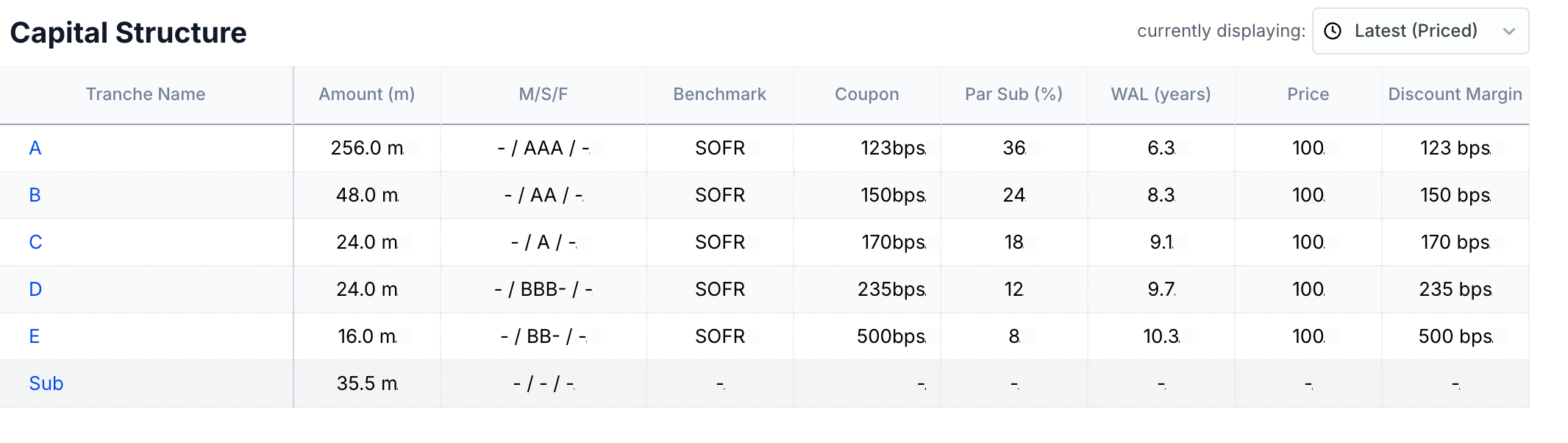
This hierarchy creates subordination, with more junior capital providing credit enhancement to the debt above it by absorbing deterioration and being a first line of defence.
Rating agencies assess rated tranches based on factors such as collateral quality, expected credit performance, subordination, and other structural protections. Actual tranche names, ratings, and capital structures vary by transaction.
How does the CLO cash flow waterfall work?
The CLO cash flow waterfall determines the order in which money from the collateral portfolio is distributed through the structure. Higher-priority fees and debt obligations are generally paid before cash can reach more junior tranches or equity, although the exact sequence depends on the transaction documents.
At a high level, the waterfall distinguishes between:
- Interest proceeds: Primarily support ongoing expenses and interest payments
- Principal proceeds: May be reinvested or used to repay CLO debt depending on the stage of the transaction
Interest proceeds waterfall
Interest proceeds are the recurring interest payments received from the underlying loan portfolio. These amounts generally move through the structure in payment priority order. They typically begin with senior obligations and move downward only after those obligations have been satisfied.
This CLO flow shows how interest income supports the structure before any residual amount can reach equity.
Principal proceeds waterfall
Principal proceeds include scheduled repayments, prepayments, recoveries, and proceeds from asset sales. These amounts may follow a different path since they're tied to the return of capital rather than recurring income.
During the reinvestment period, principal can often be used to purchase replacement loans if the transaction permits it. Later in the CLO lifecycle, more principal is typically directed toward paying down outstanding debt as the transaction moves into amortization.
How test failures can change the waterfall
The waterfall can change when specified structural tests are not met. In those situations, cash that would otherwise move to lower-priority parts of the structure may be redirected to protect more senior tranches.
This flow shows that a CLO waterfall is not always static. Structural protections can change the normal flow of cash when coverage or collateral conditions weaken. The governing documents determine the exact payment priorities, reinvestment rules, and remedies that apply to each transaction.
Who participates in the CLO market?
A CLO brings together several parties with different responsibilities across structuring, portfolio management, administration, credit assessment, and investment.
- CLO manager: Selects, monitors, and trades eligible collateral within the transaction’s limits. Because those decisions shape portfolio composition, credit quality, and concentrations, professionals may compare holdings and exposures across CLO manager profiles
- Arranger: Helps structure the transaction, coordinate issuance, and market the CLO securities to investors
- Trustee: Performs duties defined in the transaction documents, including administering payments and carrying out specified oversight responsibilities
- Collateral administrator: Maintains portfolio records and calculates information used for compliance tests and investor reporting
- Investors: Purchase different debt tranches or equity based on their return objectives, risk tolerance, ratings requirements, and mandates
- Rating agencies: Evaluate rated CLO debt using their methodologies, including analysis of collateral, subordination, and structural protections
Each participant views the transaction through a different lens, which is why CLO analysis often combines portfolio, structural, documentation, and market information.
Which assets do CLOs hold?
Broadly syndicated leveraged loans generally form the core collateral of a CLO. These loans are typically made to corporate borrowers with higher leverage or lower credit ratings than investment grade companies.
The portfolio is governed by eligibility criteria and limits that determine which assets can be included and how much exposure the CLO can take to particular borrowers, industries, or credit characteristics.
Leveraged loans as primary collateral
Individual loans can differ in borrower fundamentals, seniority, maturity, pricing, documentation, and credit quality. CLO performance ultimately depends on the businesses responsible for repaying those loans.
Documentation can also affect creditor protections and flexibility. 9fin’s Covenant Data for loans, for example, tracks more than 100 loan data points across features including baskets, portability, and structural protections.
Diversification and concentration
Diversification helps limit reliance on any single borrower or industry. Concentrated exposure can increase sensitivity when multiple holdings are affected by the same company, sector, or economic pressure.
CLO documents therefore typically place limits on certain concentrations and portfolio characteristics.
Collateral trading and reinvestment
Because CLOs are actively managed, the collateral pool can change over time. Managers may sell or replace loans to respond to repayments, changes in credit quality, or portfolio opportunities.
Those decisions remain subject to the transaction’s eligibility requirements, portfolio limits, and applicable tests.
H2: What tests and protections shape CLO cash flows?
CLO structures use coverage tests and portfolio requirements to protect debt investors and maintain defined limits on the collateral pool. When certain tests are not satisfied, the transaction documents can change how cash is distributed through the waterfall.
Overcollateralization tests
An overcollateralization, or OC, test compares a defined amount of qualifying collateral with the outstanding obligations of specified debt tranches.
If the required ratio falls below its threshold, cash that might otherwise move further down the capital structure can be redirected toward debt repayment until the test is restored.
Interest coverage tests
An interest coverage, or IC, test compares available interest proceeds with the interest payments required for specified debt classes.
Together, OC and IC tests help determine whether the structure has sufficient collateral and cash flow to support its debt obligations. Because those measures change over time, professionals may use CLO trustee report data to review historical test results and identify transactions approaching or failing specified thresholds.
Collateral quality tests
Collateral quality tests assess whether the portfolio remains within agreed parameters for characteristics such as credit quality, maturity, spread, and concentration.
The precise definitions, thresholds, and consequences vary by transaction, so the governing documents determine how each test applies.
What are the main risks of CLOs?
CLO risk varies substantially depending on the tranche and the underlying portfolio.
- Credit deterioration and defaults can reduce the cash and collateral value supporting the structure. Downgrades can also affect portfolio tests or the treatment of individual assets
- Structural risk reflects where a security sits in the waterfall. Junior positions are exposed sooner to reduced cash flows, while senior classes benefit from greater subordination
- Liquidity risk can affect the ability to buy or sell CLO securities or underlying loans at a desired price, particularly during periods of market stress
- Market-price volatility can move tranche prices even when the underlying loans have not produced realized credit losses. A lower secondary-market price therefore does not necessarily mean the transaction has incurred an equivalent economic loss
- Manager risk arises because CLOs are actively managed. Credit selection, trading and portfolio construction can influence outcomes within the boundaries of the documents
- Documentation and concentration risk can further change how individual transactions respond to stress. Investors need to assess both the contractual structure and exposures within the underlying collateral
Market conditions can also affect different parts of the capital stack differently. Recent 9fin structured-credit coverage, including its discussion of CLO trading technicals and triple-A liquidity, illustrates why tranche analysis needs to account for both underlying credit and secondary market conditions.
How do professionals monitor CLOs?
Analysis continues long after a CLO closes. Investors, managers, advisers and other market participants may need to track:
- Changes in collateral holdings
- Borrower defaults and ratings changes
- OC, IC and other test results
- Individual tranche performance
- Manager trading activity
- Amendments and transaction documents
- Primary and secondary market pricing
- Exposure to individual leveraged loan issuers
These data points interact. A deterioration in one corporate borrower may affect several CLO portfolios, while manager trading can change which transactions retain that exposure.
That makes it useful to connect deal-level information with the underlying credit market. 9fin’s current CLO coverage, for example, says its manager profiles span 160+ managers and connect holdings with deal, tranche and loan-level fundamentals.
A connected view helps professionals move from identifying a change at the CLO level to understanding the borrower, loan or market development driving it.
Research the CLO market with 9fin
Once the question of what is a CLO moves from basic structure to live market analysis, professionals need current information on deals, managers, tranches and the loans beneath them.
9fin is an AI-native platform for debt capital markets that connects CLO and leveraged finance data with specialist news, research and workflow capabilities. Teams can move between CLO structures, manager holdings and underlying borrower fundamentals without separating structured-credit analysis from the wider credit market.
Explore 9fin’s CLO coverage for current CLO data, manager research, deals and market intelligence. Request a demo to see how 9fin supports CLO research and analysis.