
Term lenders to Telesat Canada have launched a legal challenge to the Canadian satellite company’s recent transfer of Telesat Lightspeed equity, characterizing the asset shift as a “financial shell game” that both violates the loans’ credit agreement and constitutes fraudulent conveyance.
Wilmington Savings Fund Society, the administrative agent to the company’s term loans filed the complaint on behalf of lenders before the New York County Supreme Court on 21 January in a much-anticipated rebuke of the company’s decision to transfer 62% equity in its Telesat Lightspeed business into a non-guarantor subsidiary. The move, the complaint alleges, has positioned value tied to the company’s low earth orbit satellite buildout outside the creditors’ reach while the legacy geostationary satellite business is insolvent.
The agent launched a concurrent suit in Ontario’s Superior Court of Justice hours later the same day, as reported. (The docket can be found here)
“[C]reditors have proactively sought for years to engage with the Company to find a consensual solution to this foreseeable crisis,” WSFS states. “But rather than engage, the Company ignored its debtholders and audaciously attempted to transfer its crown jewel asset out of its creditors’ reach, in clear violation of its contractual obligations and applicable law.”
WSFS succeeded JPMorgan Chase Bank as the administrative agent on 6 January after the latter resigned, according to the complaint.
The lenders make the case that the buildout of the LEO business will be crucial for the company’s survival and future value as its GEO business continues to decline amidst falling revenue, EBITDA and cash flows.
“Although [LEO] does not yet have cash flows, and those future cash flows are as yet uncertain, it is already significantly more valuable than the GEO business,” the complaint states. In fact, the complaint proposes that the LEO business is the “sole source” of the Telesat’s equity value.
It is in this context — alongside the fact that the company has $1.7bn in debt coming due in December 2026 lenders say “it has no way to pay” — that the transfer was made, the suit alleges, leaving term lenders “with claims against a hollowed out and even more insolvent obligor, now comprised predominantly of the deteriorating GEO business.”
The lawsuit’s claims were made on behalf of term loan lenders holding 90% of the term loan, according to a source. The plaintiffs are represented by Paul Weiss. 9fin previously reported that a group of Telesat’s secured lenders were being advised by that firm in addition to Evercore, and Lincoln International, while PJT Partners and Kirkland & Ellis are said to be representing the company.
Telesat’s stock closed at $27.39 a share on 21 January, down nearly 21% from close on 20 January.
We took a deeper look at the lenders’ claims.
GEO decline and LEO focus
The complaint highlights that Telesat’s legacy geostationary satellite business “has been in steady, secular decline,” as evidenced by falling revenue and EBITDA from the GEO business, the company’s plan to retire a chunk of its fourteen GEO satellites in the near future, and management’s inability to make a compelling business case for a new GEO satellite, and as repeatedly acknowledged by management itself (and as noted by 9fin). With this continuing decline, the GEO business is expected by management to generate under $200m in free cash flow in 2025, compared to the over $1.7bn of debt maturing in December 2026 that the business supports, according to the complaint.
The complaint then addresses the company’s aggressive focus on developing its low earth orbit business, claiming that Telesat considers its LEO business — Telesat Lightspeed — “the centerpiece of its business and crown jewel asset.” It additionally notes that, on top of allocating virtually all capex to LEO, the company has also raised C$2.54bn in loans from the Governments of Canada and Quebec for the LEO business (while allocating warrants to the governments based on a $3bn equity valuation for Lightspeed), all while sidelining GEO.
The complaint further provides context on the collateral package and protections for Telesat’s legacy debt — $1.3bn outstanding under term loans due December 2026 at Telesat Canada, and $387m in SSNs due December 2026, $225m in SSNs due June 2027 and $213m of SUNs due October 2027, each issued by Telesat Canada and Telesat LLC — which in part has funded the Lightspeed buildout and is indicated at distressed levels.
According to the complaint, collateral for the term loan and SSNs includes substantially all assets of Telesat Canada, Telesat LLC and other affiliates and subsidiaries, including the GEO business, and the GEO entities also guarantee the debt.
The complaint claims that though LEO equity is not collateral for and the LEO entities are non-guarantor unrestricted subsidiaries under the legacy debt, these assets remain nonetheless subject to the term loan documents. Lenders that provided financing to Telesat Canada also relied on the “continued availability of the Company’s core assets — its operational GEO fleet and the anticipated LEO constellation — as credit support,” the plaintiffs claim. The complaint asserts that the credit agreement contains an “all or substantially all assets” restriction that limits the transfer of “principal assets outside the borrowers”, and the restriction extends to all assets — even interests in unrestricted subsidiaries such as Telesat Canada’s holdings in Lightspeed.
Next, the plaintiff highlights the assets transferred to the unrestricted Lightspeed subsidiaries over the years — spectrum assets and $193m in cash in December 2020 which aggregated to $1.6bn of value, per management and over C$1.4bn in cash between 2019 and 2024 per company filings — and the C$2.54bn government funding raised (C$470m drawn) at Lightspeed. All the while, management continued to reassure investors, including the term lenders, that the LEO business would not be moved out from under Telesat Canada, implying that LEO assets would continue to support legacy debt, and encouraging the lenders to “chill”.
The complaint claims that there has been general consensus (rating notes, news reports, debt pricing and company statements) that the GEO business would not be able to support, and that Lightspeed would not generate sufficient EBITDA to facilitate, a repayment or refinancing of upcoming maturities, and that the need for the company to negotiate with creditors instead of simply refinancing or redeeming debt indicates Telesat Canada is insolvent.
Despite several attempts by the term lenders to engage with the company in good faith over the years — including via a letter in April 2024 noting they were “open to considering constructive solutions for the capital structure” and six subsequent letters in following months and public statements from Telesat suggesting the company would begin creditor talks in the near term — the company did not come to the table, per the complaint.
LEO equity transfer
According to the plaintiff, despite prior assurances, Telesat Canada “secretly set in motion a plan” involving an “illegal divestiture” of substantially all of its assets into a “non-guarantor shell entity beyond the reach of its Term Lenders and other creditors”.
This plan culminated in the distribution of 62% of the equity in Telesat Lightspeed from Telesat Canada (i.e., the borrower of legacy debt) to a newly incorporated indirect subsidiary of Telesat Corporation created only eleven weeks prior to the September 2025 transaction, claims the plaintiff.
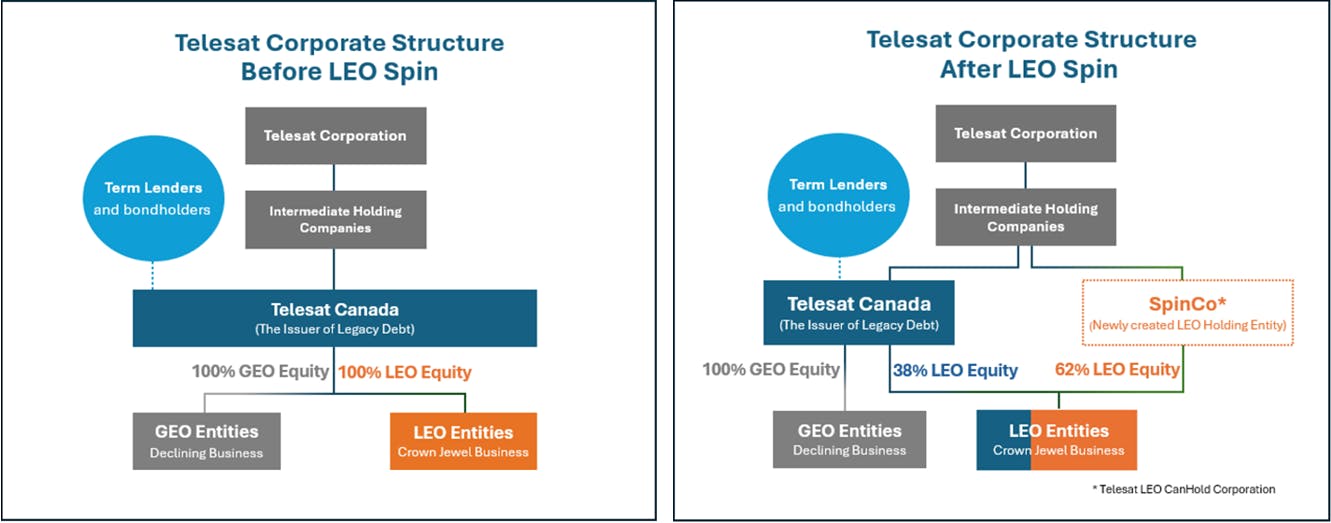
Source: WSFS complaint
As 9fin had noted when the transaction was announced in September 2025 (the complaint quotes our story), the bulk of value from the company’s future LEO business was transferred away from the reach of the company’s legacy creditors as a result.
The complaint alleges that the transaction “lacked economic substance and was merely a shell game” solely intended for the company to gain immediate leverage over creditors in future restructuring negotiations and benefit Telesat Parent shareholders.
Also alleged are conflicts of interest that have arisen from the existence of seven directors on Telesat Parent’s ten member board — president and CEO Daniel Goldberg and six nominated by controlling shareholders PSP Investments and Mark Rachesky’s MHR Fund Management — who are also directors of Telesat Canada and some of whom also “directly participate in the governance and management of the very entities that…now control the LEO business” while also holding equity in Telesat Parent.
‘All or substantially all’
The plaintiff claims that the LEO equity transfer violated the terms of the credit agreement, Section 6.03 of which prohibits transfers of “all or substantially all of” Telesat Canada’s assets unless particular conditions are met.
These conditions include: (1) a successor (i.e., the transferee in this case) assumes all obligations under the agreement, (2) no default exists post transaction, (3) the guarantors confirm guarantees, and (4) the borrower provide an officer’s certification and opinion of counsel that the transaction complied with the credit agreement. None of these conditions were met, according to the complaint.
Crucially, because Telesat “had long acknowledged that LEO was its only future-oriented platform,” and thus LEO is the “sole source” of the company’s equity value, the plaintiff claims the transaction moved substantially all of the company’s assets, leaving the term lenders with “a mere fraction of the value of [LEO] and no say in its future,” and “negligible recovery prospects.”
The complaint goes on to describe a company whose GEO subsidiaries “are encumbered by vastly more debt than their assets can support,” alongside a LEO business wherein all of the company’s equity value is derived. This point is further bolstered, the complaint says, by the fact that Telesat Canada’s book value “evaporated” after the transfer, falling to below negative C$1bn despite the entity continuing to hold 38% of LEO equity. At the same time, the parent company’s stock price soared following the LEO equity transfer, with all of its $1.8bn in market cap (when the complaint was filed; $1.4bn at the time of publication of this story) derived from LEO.
To underscore this point, the complaint goes into significant detail explaining how the company’s strategic focus has shifted almost exclusively to LEO in recent years.
“Instead of a borrower with a fully integrated LEO business working side-by-side to replace its declining GEO business—the product of years’ worth of investment and development, in part funded with the Term Lenders’ very own capital and billions of dollars in cash and assets transferred from Telesat Canada to LEO—Telesat Canada owns only a deteriorating and technologically obsolete GEO business, and a fractional minority investment in LEO Holdings, lacking control over its future,” states the complaint.
The plaintiff is seeking a declaratory judgment that the LEO equity transfer constituted a transfer of “all or substantially all” assets under the credit agreement, thus breaching Section 6.03.
A purposeful scheme to mislead, hinder, delay, and defraud
Finally, the complaint alleges the LEO equity transfer was a fraudulent conveyance because it “stripped substantial value from the Term Lenders for no meaningful consideration, when the borrower was insolvent, and was undertaken to hinder, delay, and defraud the Term Lenders”.
As the complaint had already asserted, Telesat Canada was insolvent on a cash flow basis even before the LEO equity transfer, and the transaction exacerbated the entity’s insolvency. To establish the borrower’s insolvency on a balance sheet basis, the complaint again cites Telesat Canada’s deeply negative balance sheet. Insolvency is also indicated by the fact that the company didn’t have a viable path to addressing upcoming debt maturities while funding the LEO buildout in the absence of a debt restructuring, according to the complaint.
Further, the complaint reiterates that the transfer of control of Lightspeed — the “only growth business”; the “crown jewel”— away from Telesat Canada “in a desperate bid to shield equity” left the term lenders with obligors that were already insolvent GEO entities and support from only minority equity in Lightspeed, “which amounts to textbook fraud and an intention to hinder its Term Lenders.”
Intent to hinder creditor recoveries, and to “mislead, deceive, and defraud” creditors is also evidenced by the structure, timing (no notice) and execution (deceptive conduct despite prior assurances to the contrary and lenders’ attempts to engage) of the transaction, according to the complaint. “It is hard to imagine a more deceptive course of conduct by which the Company lulled the Term Lenders into a false sense of security and then pulled the rug out from under them,” states the complaint.
The plaintiff also claims Telesat Canada did not receive any consideration in exchange for ceding control of Lightspeed, nor was there a business justification for the transaction other than for the company to gain leverage in creditor negotiations, and that the transaction suffered from numerous conflicts of interest and benefited insiders (as summarized above).
In conclusion, the plaintiff is also seeking a declaratory judgment that the LEO equity transfer be voided on the basis that it is a fraudulent conveyance in violation of Ontario law.
The plaintiff also seeks an injunction preventing the defendants from transferring further assets in violation of the credit agreement, and an award of compensatory damages.
Representatives from Telesat Canada, Paul Weiss, and WSFS did not respond to comment requests.