
Merlin Entertainments’ £657m private financing package to deal with its unsecured bonds maturing next year is being led by Monarch and Goldentree Asset Management, according to 9fin sources.
The Blackstoneand Kirkbi-backed theme park operator’s new debt, split between a $396m tranche and a €418m tranche, sits alongside its existing secured debt while also benefitting from security against a portfolio of previously unencumbered UK assets, as 9fin reported.
Merlin’s new facility — a portion of which is open to existing creditors — is priced at 650bps above the relevant benchmarks and will mature in six years, but also features a springing maturity bringing its due date to before 2030 should the company fail to refinance its debt, two sources said.
Higher borrowing costs and a challenging operating environment are opening a path for opportunistic investors more typically associated with the secondary market and workouts to try and ink some primary deals of their own, another source said.
Fun is secondary
Merlin bonds have taken a hammering in recent sessions around plans to raise new private financing, but there are signs the rollercoaster ride is back on an upswing.
The theme park operator’s new £657m senior secured term loan to refinance its senior unsecured notes due November 2027, which sit under the Motion Bondco DAC entity, was confirmed last week, as 9fin reported.
The announcement prompted a big divergence between those notes, which rallied, and other bonds within the Merlin group, such as the 2030s and 2032s at Motion Finco S.a.r.l. The yields on those notes have climbed higher, with big hedge funds selling out of them, according to 9fin sources.
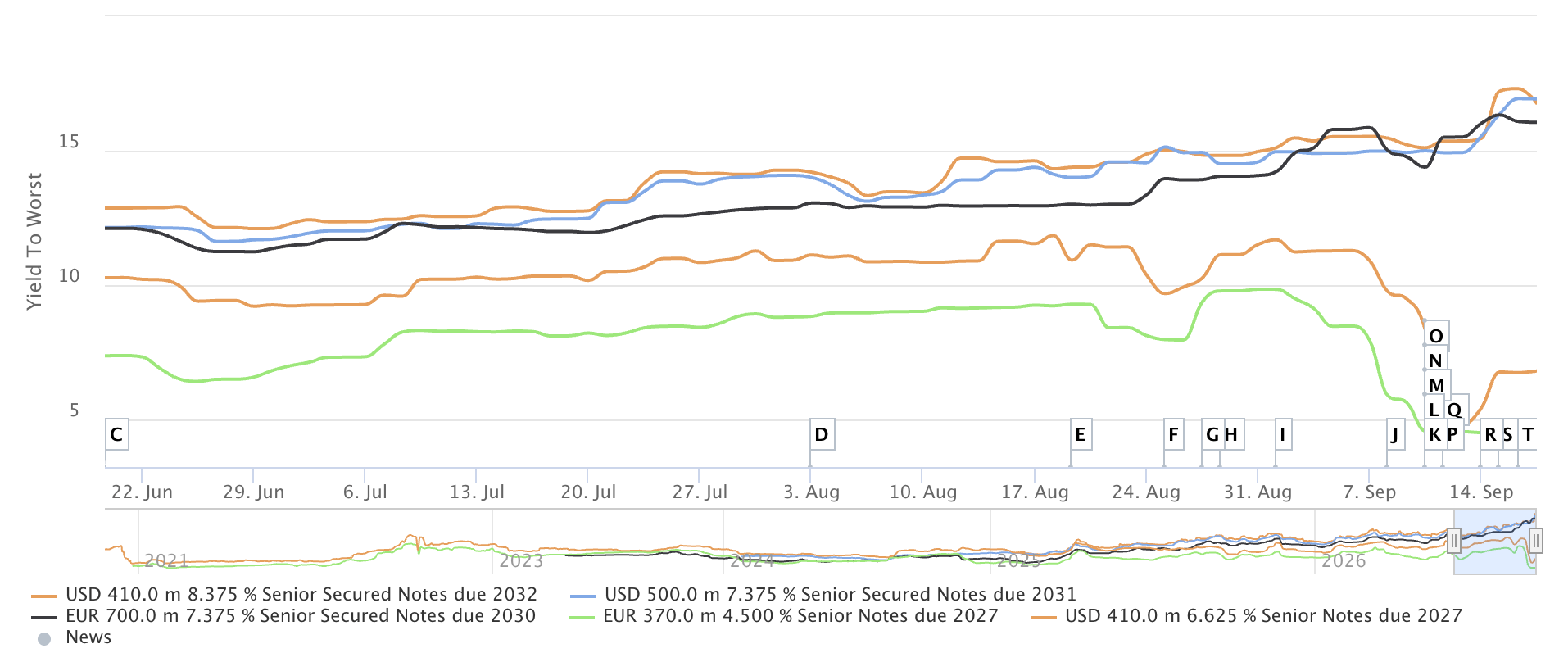
Merlin bond yields have diverged — Source: 9fin
“The 2030 and 2032s have dropped five points or so in the last few days,” noted one buysider on Tuesday, 15 September. “Maybe I’m missing something but I don’t understand why funds are selling out. The company has avoided a restructuring and the new loan is secured against less assets than I feared it would be, so to my mind there should be upside from here.”
As 9fin noted in this analysis, the disparity between the performance of different notes suggested some investors were looking beyond the removal of the near-term maturity wall to the implications of the new facility for relative creditor recoveries.
The new loan is secured against the London Eye, Sea Life London, Shrek's Adventure! London, and the UK Dungeons. Another source described the negative price action on the rest of Merlin’s debt was the result of being “primed” by the financing provided by Monarch and Goldentree, another source said.
“These assets are all essentially in one place,” said the buysider. “I was worried the collateral pool would be much wider so this feels like a big positive on how they have done the valuations.”
As per 9fin’s analysis, the remaining secured debt will likely carry a higher blended coupon against a business that has remained structurally free cash flow negative. And heading into the next round of refinancing talks with double-digit net leverage (estimated now at around 10x) would be challenging, so the company may have to start thinking about a more holistic restructuring of its cap stack.
That may also have been the read of those selling out of the 2030s, 2031s and 2032s. But stabilisation was followed by improvement yesterday (16 September), suggesting at least some market participants believe the worst scares of the ride are over.
In particular, since they hit an intraday low on 15 September the 2030s have regained two points to nearly 75, according to S&P data.
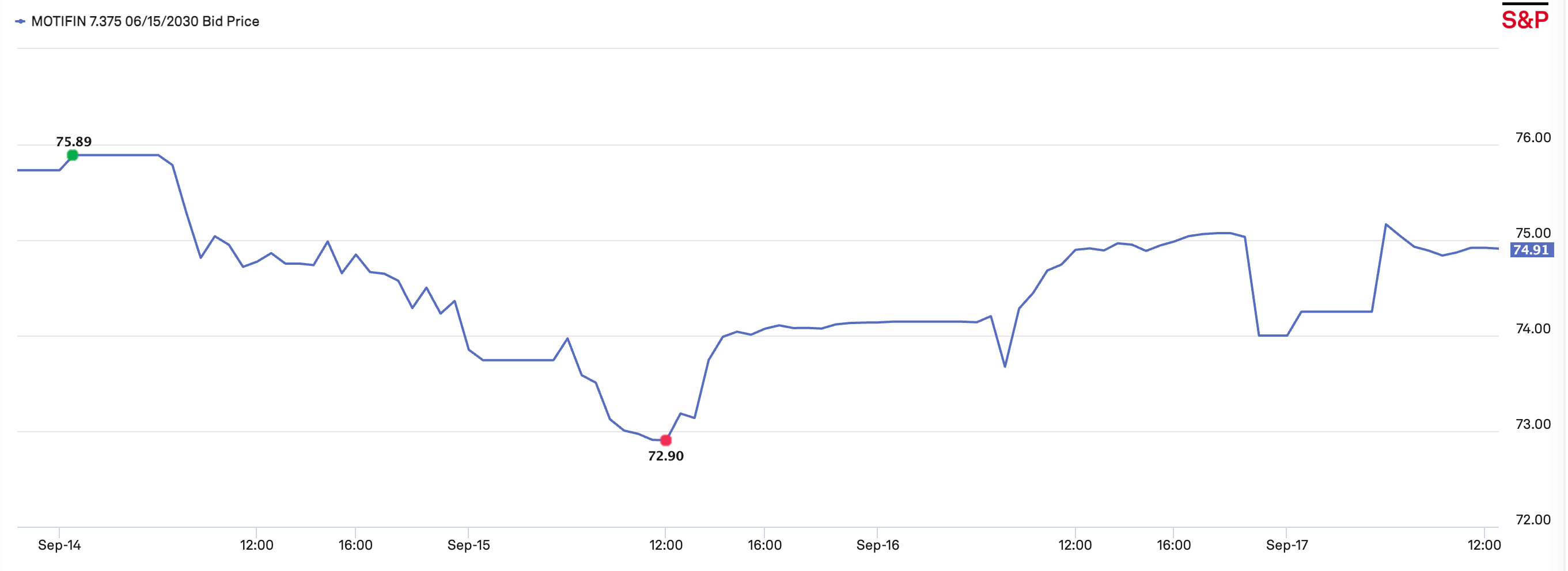
Motion Finco 7.375% June 2030 bonds have bounced back two points — Source: S&P
Likewise the 2032s have regained about two points from the low.
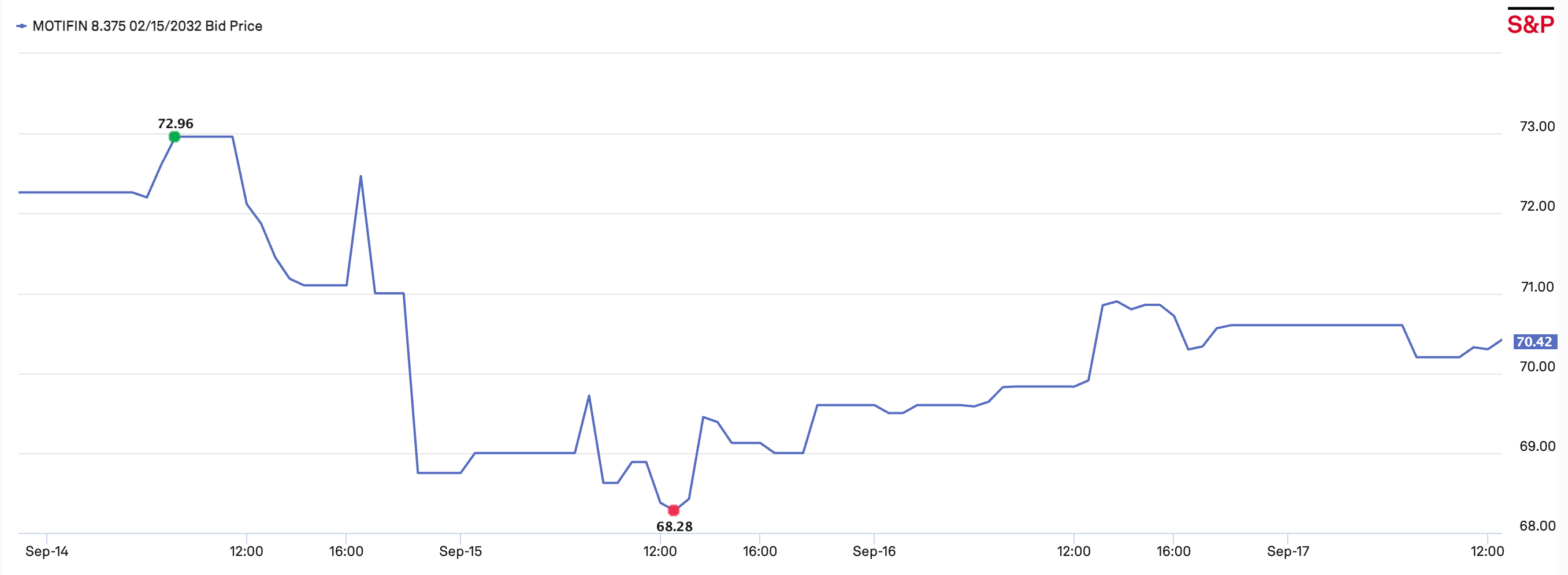
Motion Finco 8.375% February 2032s have regained two points after their drop — Source: S&P
CDS in motion
The loan plans look set to orphan Motion Bondco CDS contracts, whose spreads dropped below 150bps, according to S&P data. This has been a long-running question around Merlin, with 9fin having reported in June that Arini was among firms to have traded in the CDS. Around that time, trading noticeably picked up in the Motion Bondco contracts amid a debate over the orphaning issue. The CDS had previously been quite illiquid despite the name being a former constituent of the iTraxx Crossover index.
One source said some of the funds providing the new financing were active in the Motion Bondco CDS market too, though market participants involved in the deal have characterised the orphaning as only a by-product of the refinancing transaction.
With the removal of the 2027 bonds from Motion Bondco DAC, there will be no obligations to deliver into the CDS contracts and no link or guarantee from other group entities, said four buysiders and two derivatives lawyers. That means the theoretical value of the CDS for protection holders is zero.
“This will clearly impact any holders of Motion Bondco CDS protection,” said the first buysider. “I’m not sure there’s much reason for controversy here though, unlike some other situations like Ardagh for example. The 2027s needed addressing and there was a process of going through various proposals.”
But one of the derivatives lawyers took a different view.
“As much as people are playing it down, the orphaning of a traded CDS reference entity is a serious matter,” they argued. “It really puts a question mark on any CDS traded on DACs and similar vehicles.”
In practice, CDS spreads for high yield borrowers often floor around the 100-150bps level because there remains a chance the company will issue new debt from the entity within the remainder of a contract. And as things stand, protection sellers are not yet home and dry.
“It sounds like an orphaning,” said a second derivatives lawyer, “unless a protection buyer or bondholder is able to convince the company to give a parent guarantee to avoid the orphaning.”
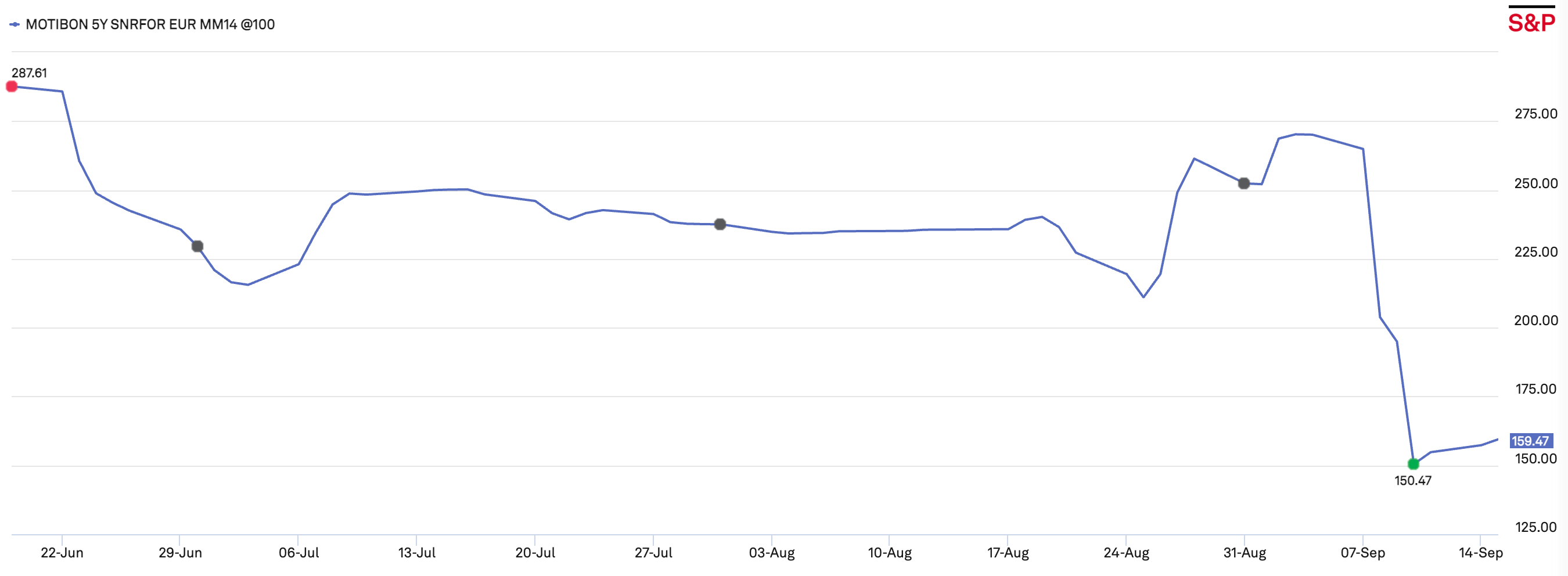
A classic orphaning move, as Motion Bondco CDS spreads dropped to 150bps area — Source: S&P
In stark contrast, CDS referencing Motion Finco are quoted very wide at 1,500bps-plus in spread terms or 31 points up front, according to S&P. The latter quotation means a buyer of protection would need to pledge 31% of the notional value of bonds they wished to protect, as well as paying a 500bps fixed running coupon.
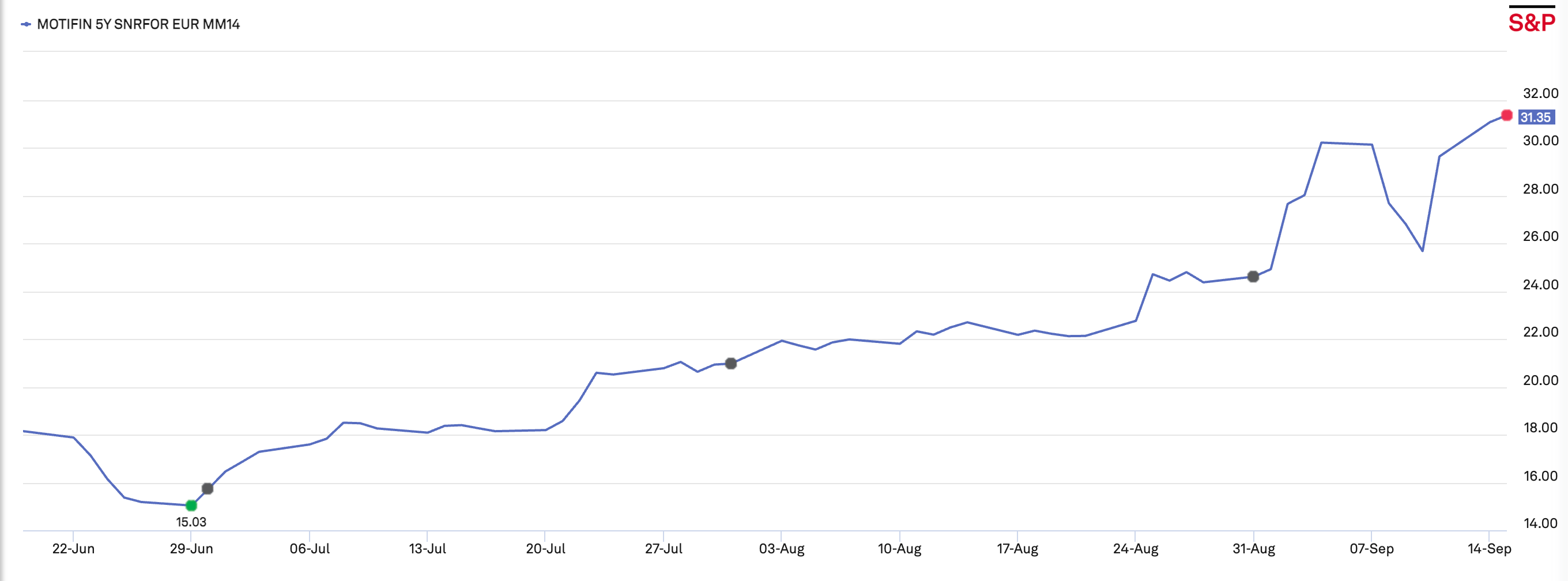
Motion Finco CDS has gapped to default levels — Source: S&P
As of today this is a theoretical construct, since the contracts have not been liquidly traded, and the CDS is based off the bonds being around 70 in price.
But this is set to change soon with Motion Finco CDS set to join the iTraxx Crossover index — in place of the outgoing Motion Bondco — when it rolls into series 46 on Monday (21 September). See here for the full iTraxx Europe series 46 index annexes.
According to the first buysider, there looks to be upside in these CDS levels, just as there is with the bonds. That’s because the default (credit event) potential appears to have diminished with the new loan deal.
“If it wanted to, Merlin could have gone the restructuring route at any point but now it makes less sense after this deal has been agreed,” said the buysider.
Merlin, Monarch, and Blackstone declined to comment. Kirkbi, Goldentree and Arini were approached for comment.