
Oak-Eagle AcquireCo announced on 15 July 2026 a fourth extension of its tender offer and consent solicitation for the Electronic Arts $750m 1.85% senior notes due 2031 and $750m 2.95% senior notes due 2051, pushing the expiration to 30 July and the settlement date to 4 August.
In the context of the Silver Lake-led consortium's record $55bn leveraged buyout of EA, funded by approximately $36bn in equity and $18bn in debt, the $1.5bn in legacy senior notes represents a minor capital component, but an oversized strategic friction point. The 101% Change of Control put provision within the notes remains an unresolved piece of the capital structure.
Compressing extension cadence signals nearing transaction close
At 15 days, the fourth extension is substantially shorter than prior extensions (50, 46, and 30 days, respectively). This steady, continuous compression without gap provides the clearest indication of the consortium's target closing timeline.
Measured expiration-to-expiration, the sequence demonstrates an offeror actively calibrating its extensions to a near-term landing date rather than settling into a prolonged waiting period.
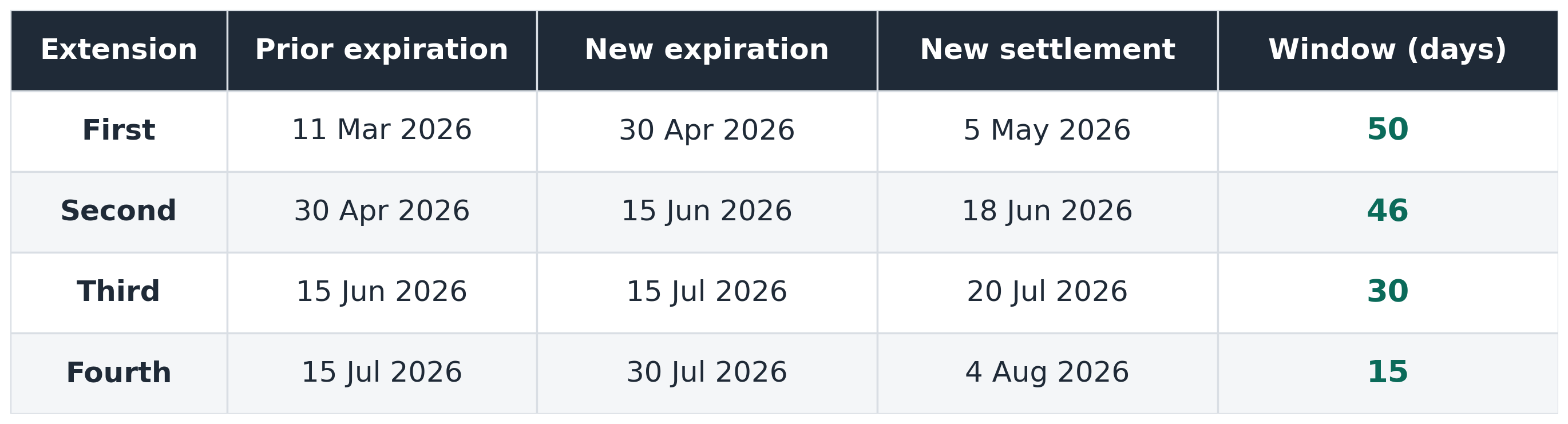
Source: 9fin analysis from company press releases via PRNewswire
This dynamic is further corroborated by the drift in the settlement date. The 4 August settlement date sits about five weeks beyond EA’s initial Q1 FY 27 closing guidance (1 April to 30 June). However, by explicitly tying settlement to a date “on or about the closing date of the Merger,” the offeror appears to be signaling that while closing has slipped past initial target windows, final consummation may be imminent.
EU regulatory landscape — Tender expiration aligns with FSR decision due date
On 23 July, the European Commission approved the competition aspect of the acquisition under EU merger rules, clearing a key EU regulatory prerequisite.
The Commission is still reviewing the deal under the Foreign Subsidies Regulation, a statutory framework imposing heightened scrutiny on non-EU state-backed acquirers, notably the consortium anchored by a sovereign wealth fund, Public Investment Fund. People familiar with the matter told Reuters that PIF is expected to win FSR clearance, with the Commission's decision due by 30 July.
Crucially, the offeror’s selection of 30 July for the fourth tender expiration aligns directly with this regulatory decision point. Rather than selecting an arbitrary calendar interval, AcquireCo has pegged the tender window directly to the EU regulatory milestone, providing the clearest link yet between tender mechanics and merger consummation timeline.
Participation still reflects creditor unity
Participation figures demonstrate sustained creditor alignment behind the noteholder group advised by Akin Gump and Houlihan Lokey:
- 2031s: $68.8m tendered of $750m outstanding, or around 9.2%, up $233,000 from the $68.6m reported on 15 June
- 2051s: $7.9m tendered of $750m outstanding, or around 1.06%, unchanged
Combined participation remains frozen at approximately $76.7m across both series, roughly 5.1% of the $1.5bn total. Requisite consents to adopt the proposed covenant amendments have not been received for either series.
Recent tender considerations rose marginally, to $876.41 per $1,000 for the 2031s and $696.18 for the 2051s, up $0.59 and $0.22 respectively. These moves appear mechanical, reflecting a zero-spread price recalculated to a later settlement date rather than any change in the offer's economics.
Defeasance language unchanged after Fitch's exit
Fitch’s June withdrawal of its expected ratings, following the 16 June revised Defeasance Trust Agreement, eliminated one analytical pathway for bypassing the 101% Change of Control put.
AcquireCo’s 15 July release does not alter its defeasance language, reiterating its intention to cause EA to defease any un-tendered notes upon closing without requiring noteholder consent.
With Fitch out of the analytical framework, the indenture mechanics pivot back to the two contractually named agencies: Moody’s and S&P. If Moody’s withdraws its rating upon defeasance (consistent with its March guidance) and S&P rates the defeased notes against EA’s post-closing corporate credit profile (as foreshadowed in February), both contractual prongs for triggering a Ratings Event, and consequently the 101% put, could be satisfied at closing.
Strategic takeaways and outlook
Viewed strictly in isolation, static participation levels (~5%) and unchanged defeasance language suggest an ongoing impasse. However, the cadence of the extensions provides a more tangible signal.
Four consecutive, shortening extensions ending precisely on the EU FSR decision date may indicate an offeror positioning for imminent deal execution. Upon receipt of FSR clearance, the sponsors may be positioned to finalize the capital structure, attempt to unilaterally execute the defeasance mechanics, and bring the transaction to a close.