
BDC bonds have rebounded from their lows in March when fears of AI disruption to software business models blew out spreads for these private credit investment vehicles.
Much of the rebound is tied to the recognition that the apocalyptic scenario some envisioned for the tech industry was more of a distant worry rather than an imminent issue. But some investors in the space are also taking comfort in another thesis — debt tied to BDC vehicles at current levels offer superior yields and protections than those offered by highly rated CLO tranches.
“I do think understanding that relative value makes sense in your calibration, and today it points to the direction of BDCs,” said Adam Abbas, head of fixed income at Harris Oakmark, noting that was in part driven by how tight CLO spreads were.
For example, tier-1 US CLO triple-A tranches are currently printing around SOFR+120bps, equivalent to a yield of just under 5%, according to 9fin data. Meanwhile the mean spread for recently issued index-eligible BDC bonds was T+210bps, for a yield around 6.3%, according to Raymond James as of 21 May.
On its face, this could appear like comparing apples to oranges. BDC bonds cater towards investment-grade investors and CLOs are sold primarily to buyers of structured credit.
Market participants nonetheless point out they share common ground. Both are over-collateralized investment vehicles that own and actively manage a diversified pool of loans from highly indebted corporate borrowers.
Lenders could therefore evaluate the two structures based on their loan-to-value, seniority, or other apt metrics.
Apollo’s insurance arm Athene articulated that view earlier this month. In its recent fixed income investor call on 15 May, the insurer said the relative value for BDC debt was attractive compared to the highest rated CLO tranches.
“A key point to keep in mind is this: BDC debt has lower LTVs and more credit enhancements than AAA rated CLOs,” said James Belardi, Athene’s CEO. “That's a pretty powerful statement. I think we find it attractive because of the spread difference versus other assets we can buy.”
To demonstrate that, Athene showed in the slide below that a triple-A rated CLO would see impairment much sooner than a BDC bond, which sits senior to the equity but lower than borrowings from bank credit facilities.
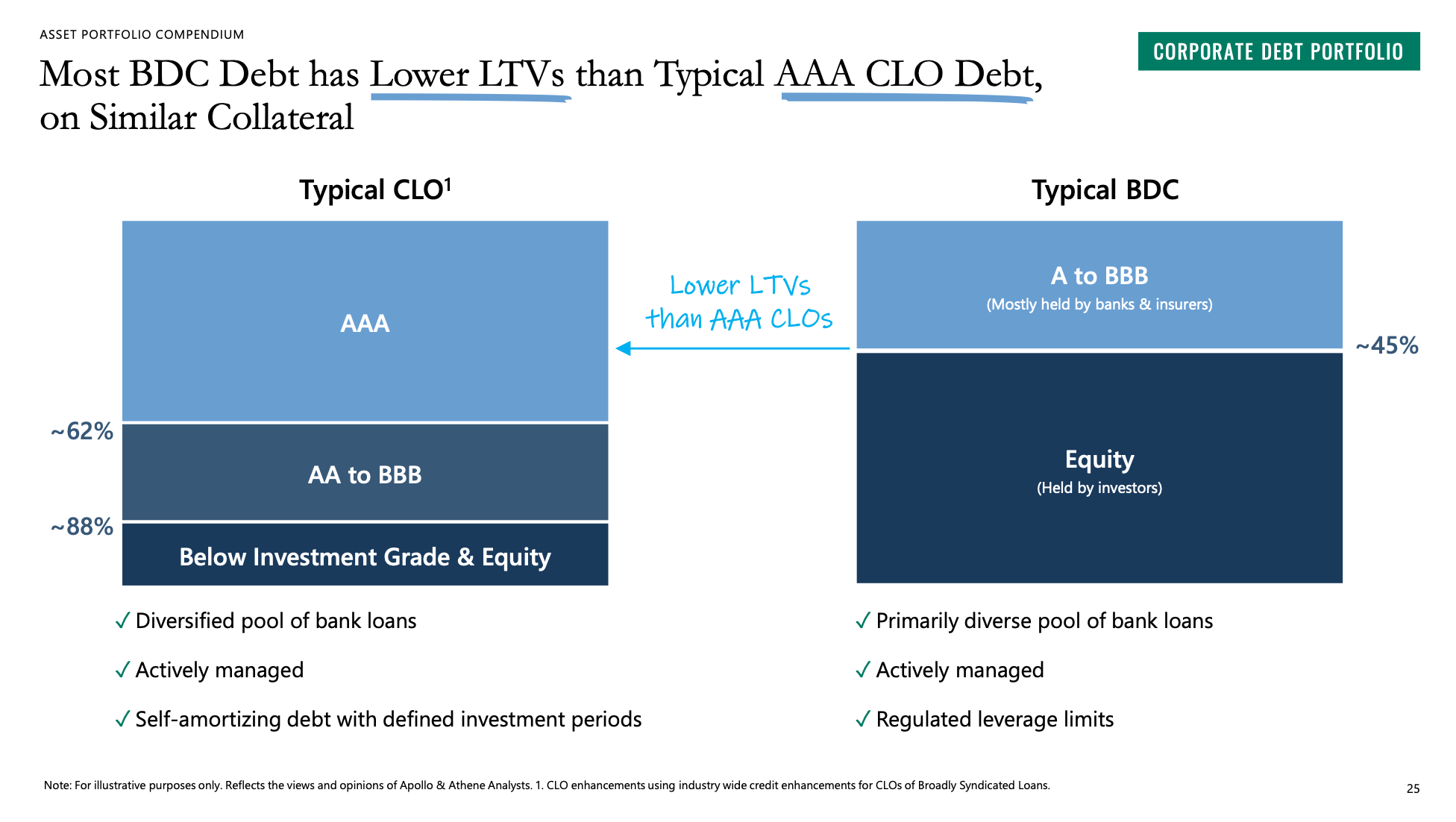
Athene’s asset portfolio compendium
As of December, Athene disclosed it had $9.4bn of BDC bonds, with around one third of it in the form of private placements. For example, Athene owned $1.9bn of Blackstone Private Credit Fund’s debt, $1.2bn of Blue Owl Credit Income Corp’s bonds, and $1.1bn of HPS Corporate Lending Fund’s debt, according to an investor presentation.
In the same presentation, it showed it was slowly cutting back its allocation to CLOs throughout last year.
Gaining currency
The argument for comparing BDC bonds to CLOs is finding traction.
After all, multi-strategy credit funds divvy up investments based on their relative value all the time. Extending that to the analysis of BDC bonds was only logical, said a buyside analyst at one such manager.
Sellside analysts including those at Barclays have helped propagate that view, though one securitized credit PM focusing on CLOs saw the comparison made more frequently among hedge funds with higher return targets.
Alongside this growing idea, there has been increasing debate over whether a triple-A CLO tranche is even an appropriate point of comparison.
“It should be more like a single-A rated CLO because of the way the underlying BDC loan portfolios are single-B companies, and the vehicle is un-levered — LTVs are pretty low,” said the buyside analyst.
Others said that vehicles tied to larger alternative asset managers with more conservative loan books and stronger underwriting capabilities such as Blackstone Private Credit Fund should be benchmarked against higher rated CLOs.
But CLOs haven’t been sitting idle and have adopted a more conservative posture, complicating calculations on relative value. They’ve cut exposure to triple-C loans while increasing their positions in single-B rated debt in 2026 so far, according to JP Morgan research.
Regardless of where one landed in this debate, the growing willingness to do the maths all points to the increased sophistication of the BDC investor base that had previously viewed the instrument as an easy, high-octane way to earn spread.
“The market is getting smarter and smarter on how they do that tethering, as opposed to just historically, they really wanted to treat [BDC paper] as almost like credit beta,” said Abbas. “Buysiders are learning … these are pretty well insulated vehicles that are much more resilient than people realize.”